
Over 50 years of Tourism Advocacy
Building India's Travel Businesses

Travel and Tourism: Unlocking India’s Global Potential

This is why WTTC was created: to speak globally with one voice. For more than 30 years, we have conducted economic impact research, and our members gather once a year at what we call the Davos of Travel and Tourism. Our last global summit was held in Rome, hosted by Giorgia Meloni. It is where we shape the global agenda, with members representing hotels, airlines, airports, cruises and travel companies. I am very happy that you are shaping the agenda for India, because that agenda changes lives.
 Let us look at the facts. In 2025, we faced many challenges: the war in Ukraine, the gas situation and hurricanes. Despite all this, while the global economy grew by 2.8 per cent, travel and tourism GDP grew by 4 per cent, reaching US$11.6 trillion. The sector supported 366 million jobs—one in every nine worldwide.
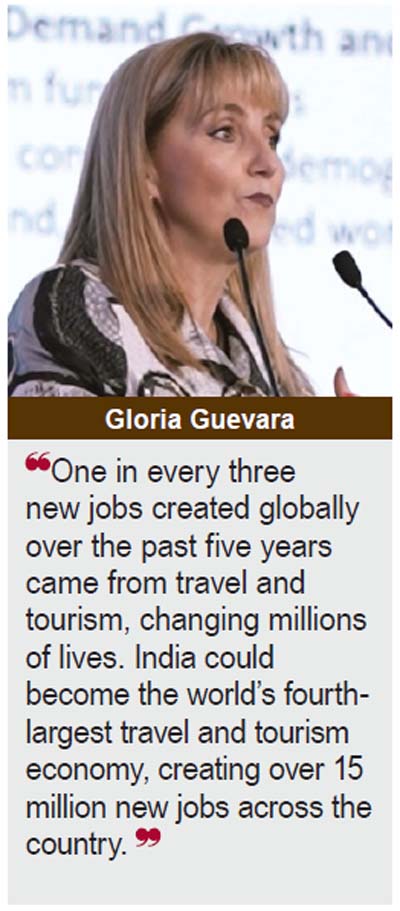
The number I like most is this: of all the jobs created across sectors during the past five years, one in every three new jobs on the planet came from travel and tourism. That is the contribution of the work you all do. We change lives and provide opportunities to millions of people around the world.
International visitor spending reached US$2 trillion, while domestic spending reached US$5 trillion. Looking only at the direct contribution, travel and tourism grew by 3.5 per cent and outpaced every other sector. We reached a new high of 1.5 billion international travellers and broke many records compared with 2019.
Where did the growth come from? Asia Pacific was the fastest-growing region, at 8 per cent. Africa grew by 5 per cent and the Middle East by 5.3 per cent, while Europe grew by 2.6 per cent and North America by only 1 per cent. India performed better than the global average, growing by 7.3 per cent. This was a fantastic achievement.
These comparisons matter. I recently visited the United States, China and Japan to share the same data and discuss what was driving their performance. The United States remained strong in domestic travel, but its international performance was weak and overall growth was only 0.9 per cent. Europe is a mature market, while Asia Pacific is booming, with countries such as Japan, South Korea and Thailand performing strongly.
Domestic tourism is the foundation for every country, and I encourage everyone in India to discover their own country. But international tourism is also essential. Both outbound and inbound travel help support strong connectivity, while inbound tourism brings visitor spending into India.
Globally, international visitor spending grew by 3.2 per cent to reach US$2 trillion. Asia Pacific recorded growth of 8 per cent, while North America declined by 3 per cent and Europe was almost flat. India also experienced a decline in international spending last year: the country received less money from international visitors than in the previous year. This is an important opportunity to address.
Around 1.5 billion travellers crossed international borders—80 million more than the year before. Almost half travelled to or within Europe, while 347 million went to Asia Pacific. In India’s case, the figure was 18 million. About half were international travellers and the other half were Indians living abroad who came home. We count them because they spend money even when they stay with family and friends. We need more of them to return, spend and become ambassadors for India.
The number of visitors alone does not tell the complete story. France receives the largest number of international visitors and Spain ranks second, yet travellers spend more in the United States and China. India should therefore pursue not merely greater arrivals, but visitors who stay longer, travel more widely and contribute more to the economy.
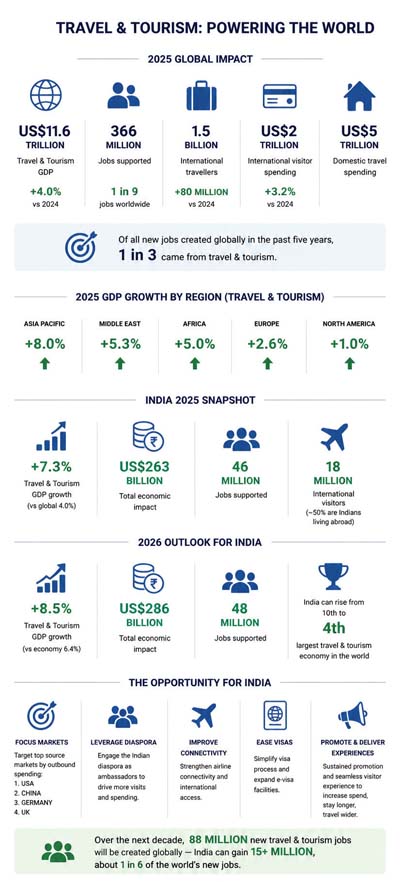 India’s overall GDP growth of 7.5 per cent is very impressive, and travel and tourism grew by 7.3 per cent—again, above the global average. The sector is worth US$263 billion in total impact and supports 46 million jobs. Domestic tourism is growing strongly, but there is also a major international opportunity that government and industry can unlock together.
We believe India will set another record this year. While the economy is expected to grow by 6.4 per cent, travel and tourism is forecast to grow by 8.5 per cent, reaching US$286 billion and supporting 48 million jobs. This is why I encourage all of you to continue working together, supporting the government and joining forces to unlock the country’s potential.
India could move from being the tenth-largest travel and tourism economy in the world to the fourth-largest. The sector could more than double in size in the years ahead. The question is how quickly you can unlock that potential. Globally, 88 million travel and tourism jobs are expected to be created over the next decade, and India could gain more than 15 million of them—about one in every six. These jobs will not be confined to the big cities; they will be created across the country.
Where should India concentrate its efforts? Look at the countries generating the greatest outbound spending. The United States ranks first, followed by China, Germany and the United Kingdom. These are the markets I would target through segmentation, investment in promotion and compelling experiences. Focusing on even the top ten source markets could significantly increase India’s share.
India should also engage its large diaspora. There are many successful Indians living in the United States, Europe and elsewhere. Every time they return, they can become ambassadors for Indian tourism. First-time visitors, too, should leave wanting to return and bring others. The opportunity is enormous, but tourism is a competitive business and India must actively pursue its fair share.
Partnership is essential. As a former tourism minister, I understand the internal battles over cabinet priorities, budgets and policy. WTTC would be pleased to support India with data and evidence, including recommendations on policies that can create more jobs. Measures such as easier visas can unlock growth. The recent progress on online visas is a great initiative, but more can be done.
Airline connectivity is equally important, as is making the visitor journey seamless and building international demand through sustained promotion. India already possesses the assets; it does not have to create them. This country is extraordinarily rich in culture, nature and gastronomy. Every region is different and unique—it can feel as though India contains 30 different countries within one.
I have been here for less than 48 hours and am already fascinated by the food—and have probably gained two kilos. That experience itself shows the strength of what India can offer. Its diversity is not an abstract idea; it is something visitors can taste, see and experience wherever they travel.
The task now is to join forces and unlock this potential. WTTC is ready to help take India to the next level and secure its fair share of global tourism. Our research covering 184 countries is freely available, allowing you to compare performance across markets and over time.