
Over 50 years of Tourism Advocacy
Building India's Travel Businesses

From Stars to Segments How the Language of Hotels Grew Up

Three frameworks, three audiences, one asset and why India’s hotel market now needs fluency in all of them!
There is a moment in most serious hotel conversations in India where someone pauses and asks: “But what star category is it?” It is a reasonable question. It has been the default framing for decades. But understanding why that framing is now only one part of a larger picture is one of the more useful shifts an owner or developer can make today.
This is not a story about one system being wrong. It is a story about three systems, each built for a different audience, each answering a different question.
The Star System: Built for Baseline Assurance: India’s star classification, administered by the HRACC under the Ministry of Tourism, was designed to give travelers a reliable signal about what they were walking into. Room dimensions, fire safety, service standards a baseline that a government body could verify and a guest could trust.
Star Accrediation
It does exactly what it was designed to do. And in India specifically, it carries real financial weight beyond the facade plaque. Government incentives, subsidies, tourism development grants, and state-level benefits are frequently structured around star category.
Stars in India are not ceremonial. They are a genuine policy and financial instrument. The question is simply whether they are the right instrument for every conversation.
The Chain Scale: Built for the Market In 1985, Randy Smith founded Smith Travel Research – STR, now part of CoStar to build a performance database for the hotel industry. The framework he created, chain scale segmentation, approached classification from a completely different direction.
Hotel Position
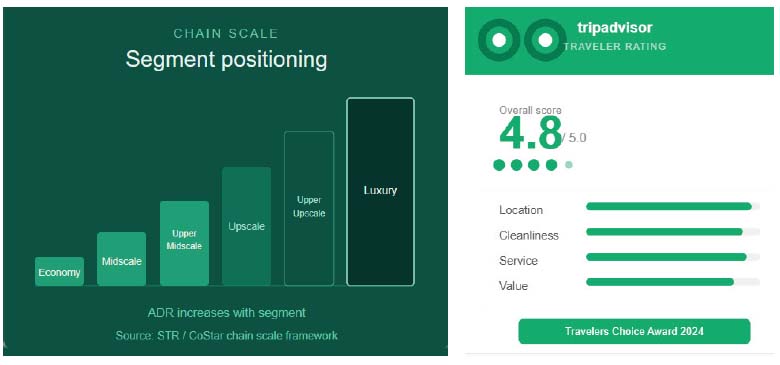
 Rather than measuring what a hotel had built, it measured what the market paid for it using actual average daily rates across brand portfolios, recalibrated annually. The six tiers – Luxury, Upper Upscale, Upscale, Upper Midscale, Midscale, and Economy are defined by real market performance, not facility checklists.
This became the operating language of every serious hotel market globally, and increasingly of India’s institutional capital. These are the numbers that drive valuations, underwriting, and brand negotiations not star classifications.
When an operator sits across the table to negotiate a management contract, they are thinking in chain scale. When a PE fund underwrites a hotel, they benchmark against segment performance. A developer who walks into those conversations speaking only in stars is working without the full vocabulary the room is using.
The Guest Rating: Built by Travelers Themselves: While governments used stars for policy and investors adopted chain scale for performance, travelers quietly built their own classification system entirely
Guest Ratings -Tripadvisor
The rise of booking platforms and review aggregators created a third layer – one based not on government inspection or brand affiliation, but on the aggregated experience of actual guests. Today, a significant and growing share of travelers, particularly India’s domestic leisure segment, choose hotels based on platform scores, destination rankings, and specific attribute ratings rather than star categories.
The result is occasionally striking. A well-run independent property with genuine character and consistent service can carry guest ratings that outperform a classified 5-star that has aged or delivers inconsistently. Travelers have, in practice, built a segmentation system of their own and it is the one that increasingly determines whether a hotel wins or loses a booking.
Three Systems, One Asset
The most useful way to hold all three is to understand what each one is actually for.
Stars answer the regulatory and policy question does this hotel meet the standards required for its category, and does it qualify for the government benefits that come with that classification? Relevant for compliance, incentive access, and project financial structuring.
Chain scale answers the investment and operations question where does this asset sit in the competitive market, and how should it be financed, operated, and valued relative to comparable branded supply? Relevant for every operator, lender, and investor conversation.
Guest ratings answer the market positioning question how does the actual experience of staying here compare to what travelers can find elsewhere in this destination? Relevant for RevPAR performance, booking conversion, and the organic demand that no loyalty programme fully replaces.
These are not competing frameworks. A hotel can pursue its star classification for the policy benefits it genuinely delivers, position itself in chain scale terms for institutional conversations, and invest in the guest experience that builds the ratings now driving booking decisions on the ground.
The Opportunity
India’s hotel market is growing at a pace that has no real precedent. Investment surged multifold year-on-year. Tier II and III cities captured half of transaction volumes and 70%+ of branded signings. Nearly 50% of the future supply pipeline targets the midscale to upper midscale segment a precise chain scale statement about where demand is forming.
The owners and developers building the most durable assets in this cycle are those fluent in all three conversations who understand what their star category delivers, where they sit in the chain scale, and what their guest experience needs to deliver to compete on the platform scores that travelers now use to choose.
The star on the facade, the segment in the deal document, and the score on the booking platform are each answering a different question – for a different audience, at a different stage of an asset’s life.
Knowing which question you are trying to answer, and which tool to reach for, is what makes the difference.
ABOUT THE AUTHOR
Nikhil Shah, CFA is Senior Executive Director – Hotels & Hospitality, Capital Markets, India at CBRE, based in Mumbai. With two decades of experience spanning hospitality investment, banking, private equity, and capital raising, he leads transaction advisory and investment strategy for India’s hospitality sector within CBRE’s broader Asia Pacific platform. This article was first published on his Linkedin page.