
Over 50 years of Tourism Advocacy
Building India's Travel Businesses
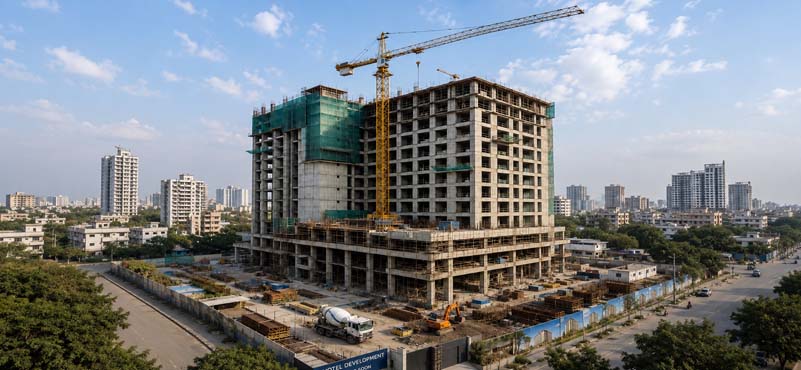
India’s Hotel Boom Is Raising the Stakes for Capital Planning

India is witnessing one of its strongest hotel expansion cycles in recent history, with branded supply spreading across metros, secondary cities, leisure destinations, pilgrimage centres, and emerging markets. Yet beneath this growth story lies a growing challenge: hotel development economics are becoming increasingly complex.

Historically, hotel feasibility discussions focused largely on occupancy, ARR, RevPAR, and market demand. While these metrics remain critical, development cost has emerged as an equally important determinant of project viability. In today’s environment, capital discipline is no longer a post-design exercise—it is becoming the starting point of successful hotel development.
A hotel may sit in a strong market with healthy demand, but if the capital outlay is not aligned with the achievable rate, scale, design and positioning, returns can quickly come under pressure. In today’s environment, capital discipline is no longer a post-design exercise. It is becoming the starting point of successful hotel development.
Why Development Costs Are Rising
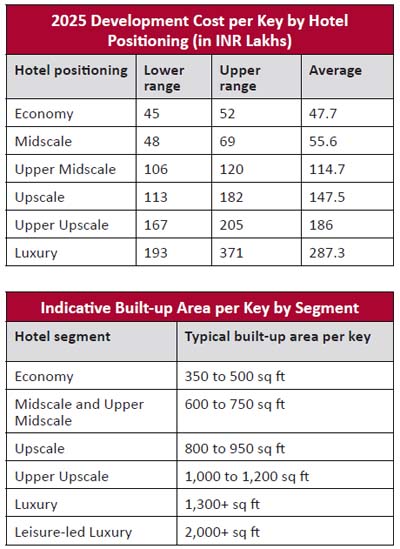
Hotel development costs in India have moved into a structurally higher pricing band, with development cost per key recording an estimated year-on-year escalation of 8 to 12% in 2025, pushing project economics into a very different territory from what many developers were working with just a few years ago. While construction inflation has certainly played a role, the increase is not being driven by material costs alone. Rising prices of cement, steel, labour, electrical systems, interior finishes, and imported components have contributed to higher project costs. However, a more fundamental shift is also underway.
 Hotels today are expected to deliver a far broader and more sophisticated guest experience than they did a decade ago. Larger public spaces, multiple dining venues, wellness facilities, technology-enabled experiences, and stronger sustainability standards are increasingly becoming part of the development program. At the same time, operators continue to evolve brand standards, placing greater emphasis on design differentiation, guest experience, and operational efficiency.
Development complexity has increased as well. Projects now require more advanced building systems, larger back-of-house infrastructure, stronger life-safety standards, and greater coordination among consultants, designers, operators, and project managers. In many cases, developers are also dealing with longer approval cycles and more stringent regulatory requirements. As a result, costs are increasing not simply because inputs have become more expensive, but because hotels themselves have become more complex to design, build, and operate.
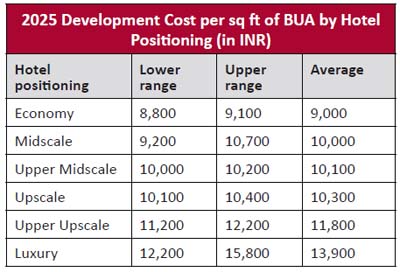
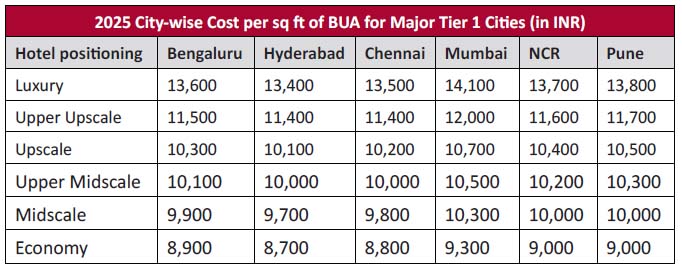
 Current benchmarks suggest that hotel development costs in India, excluding land, statutory charges, and interest during construction, generally range between INR 9,000 and INR 14,000 per sq ft of built-up area. Dense urban developments can move even beyond these benchmarks because of vertical construction, basement requirements, site constraints, and compliance complexity.
Why Moving Up the Positioning Ladder Gets Expensive Development costs rise steadily as hotel positioning rises.
Economy hotels represent the most efficient development model, while midscale hotels continue to offer one of the strongest balances between affordability, scalability, and operational efficiency, helping explain their dominance in India’s branded hotel pipeline.
Costs increase significantly as hotels move into the upper-midscale, upscale, and upper-upscale categories, driven by larger guestrooms, expanded public areas, additional dining venues, more sophisticated building systems, and stronger design requirements. Luxury hotels operate within a much wider range, particularly in resort environments where extensive landscaping, wellness facilities, outdoor amenities, and experiential programming add substantial cost. Increasingly, luxury hotels are being conceived as destination assets rather than pure accommodation products, adding further complexity to development economics.
A key reason for the variation in development costs lies in the amount of space allocated per room. As hotels move up the positioning spectrum, guestrooms become larger and a greater share of the project is devoted to public areas, amenities, circulation spaces, and back-of-house infrastructure. As a result, higher-positioned hotels are not simply more expensive because of better materials; they also require significantly more built-up area per key.
Location Matters as Much as Positioning
Development economics are influenced not only by what is being built, but also by where it is being built. Tier 1 cities continue to command a development premium because of higher construction complexity, labor cost, site constraints and regulatory intensity. Markets such as Mumbai, Delhi NCR and Bengaluru, are particularly sensitive to rising development costs because project outlays have increased substantially while room-rate growth may not always keep pace. Dense urban-core and CBD locations can command a 10 to 20% premium over base benchmarks due to deeper excavation, basement requirements, difficult site logistics and premium execution conditions. Among the major metropolitan markets, Mumbai remains the most expensive city across most positioning categories.
By contrast, Tier 2 and Tier 3 markets can offer more favorable development economics, particularly when compared with dense Tier 1 locations where development costs can exceed base benchmarks by 12 to 15%, and CBD or urban-core locations can command a 10 to 20% premium due to excavation, basement construction, site-logistics constraints and execution complexity. Lower land pressure, improving contractor ecosystems, regional demand growth and expanding infrastructure are helping these markets attract more branded hotel interest. However, lower cost does not automatically mean lower risk. Emerging markets require careful calibration of product size, positioning, amenity mix and brand standards. Overbuilding a hotel relative to the achievable ARR can weaken returns even if the absolute development cost is lower.
Location typology introduces another layer of complexity Peripheral urban and transit-oriented corridors are often 5 to 10% below CBD equivalents, supported by easier construction logistics and better scale efficiencies. Semi-urban, pilgrimage and emerging tourism destinations generally sit at the lower end of cost ranges. These markets are increasingly relevant because domestic travel demand is becoming more distributed, but they require tighter cost discipline and more practical design decisions.
Beyond Construction Costs: The Cost of Delays
Another factor that is increasingly influencing hotel development economics is project timelines. In many cases, cost escalation is not driven solely by construction inputs, but by the time required to bring projects to completion. Multiple approvals, regulatory clearances, utility connections, environmental permissions, and local compliance requirements can extend development timelines and increase overall project costs.
Unlike sectors such as affordable housing, logistics, or infrastructure, hotels in India do not benefit from infrastructure status. As a result, developers often face higher financing costs and more limited access to long-tenure funding. When combined with project delays, this can significantly increase interest during construction and overall capital requirements. As hotel development expands into newer markets and more complex mixed-use projects, improving approval processes and enabling easier access to financing could become as important as controlling construction costs in improving project viability.
Capital Discipline Is Becoming a Competitive Advantage
The evolution of hotel development cost in India therefore reflects a broader shift in the sector. Demand is expanding beyond traditional metros, and branded supply is spreading across a wider range of markets, and development opportunities continue to grow. At the same time, the margin for error is narrowing. With hotel development costs in India moving into a structurally higher pricing band, including an estimated year-on-year escalation of 8 to 12% in development cost per key in 2025, decisions around project scale, positioning, design and capital allocation have become even more critical to long-term project success.
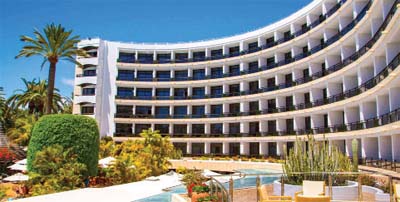 The next phase of successful hotel development will depend on sharper cost benchmarking, better design discipline and a more realistic understanding of segment and location economics. Midscale and upper midscale hotels are likely to remain attractive because they offer a strong balance between development cost, scalability and domestic demand. Luxury and upper upscale hotels will continue to work in markets where rate potential, brand strength and asset positioning justify the higher outlay. As India’s branded hotel sector expands across a wider range of cities and destinations, success will depend not just on identifying the right demand opportunity, but on aligning product ambition with capital reality.
Across categories, however, the central message is the same: capital discipline is no longer a back-end feasibility check. In an environment of rising development costs and increasing project complexity, it has become the foundation for creating hotels that can deliver sustainable long-term returns.
 (Note: This article is based on insights from the HVS ANAROCK–Gleeds 2025 Hotel Development Cost Report, which provides a detailed assessment of hotel development costs across segments, city tiers, and location typologies in India. The complete report is available on the HVS ANAROCK website.)