
Over 50 years of Tourism Advocacy
Building India's Travel Businesses
The Power of Entrepreneurship

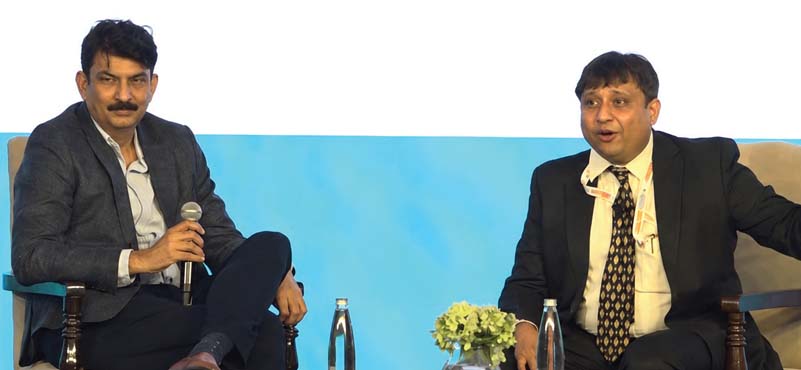
A conversation between Rajesh Magow, Co-founder and Group CEO, MakeMyTrip, and Aashish Gupta, CEO, FAITH
Aashish Gupta: You and your co-founders saw the internet opportunity very early and had the conviction to stay with it. What was the original impulse behind MakeMyTrip?
Rajesh Magow: Fundamentally, we wanted to do something on our own. We wanted to become entrepreneurs. None of us came straight out of college. Deep had thought about the idea, but he too had been working, as had I and the other co-founders who joined us. We had all spent a few years as professionals, and that was where the meeting of minds happened. Interestingly, we did not know one another before. We met at MakeMyTrip and began the journey together.
The other part of the idea was digitisation, which is now taken for granted. We saw the internet coming very early. In fact, we were almost pre-sunrise. When we started in 2000, the internet ecosystem in India was practically non-existent. We believed that new business models would be built on technology, and we wanted to be part of that world.
For nearly five years, however, the market did not really arrive. The internet only began gathering momentum around 2005 or 2006. What kept us going was conviction. There was never any serious doubt in our minds that it would happen; the only question was when. We wanted to build for the long term. So the two fundamental motivations were clear: to create something of our own and to build it around the internet and technology.
 Aashish Gupta: MakeMyTrip has constantly reinvented itself from that original idea. How difficult has that transition been?
Rajesh Magow: Anyone entering a technology business must be prepared for life to change every few years. New innovations and new technologies will keep arriving, and they will continually alter the way you operate.
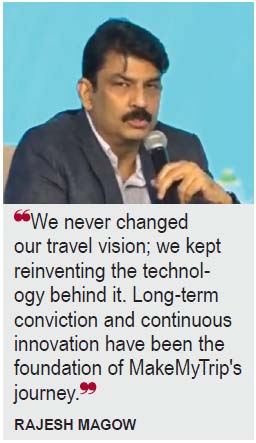
I would not say that our fundamental business model kept changing. We entered travel through technology, but the travel vision remained intact. From the very beginning, we wanted to become the travel service provider for every Indian traveller. That never changed. There were many variations and adjustments along the way, but the core stayed steady.
What changed dramatically was the technology around us. Every three, four or five years, and now perhaps every couple of years, a new wave arrives. It can become a threat because you may have invested heavily in one platform while a newer technology enables a fresh player to disrupt you. At the same time, it gives you an opportunity to improve everything you do.
It is like changing the wheels of a car while it is moving at very high speed. You cannot stop serving customers while rebuilding the platform. We began in a desktop world when the internet itself was barely present. Then digitisation accelerated. Desktop gave way to mobile, and within mobile you had different operating systems such as iOS and Android. Each change meant retraining engineers, redesigning the front end, rethinking the back end and ensuring that the customer still experienced a completely seamless service.
That is easier said than done. You have to keep investing, see the change early and continue innovating. So, for us, the business model was not being reinvented every time; the technology enabling it was.
Aashish Gupta: Travel has also faced repeated crises. Large companies often feel the shock more deeply. How did you recover when the pandemic brought everything to a halt?
Rajesh Magow: We have had several near-death situations, but the pandemic was the mother of all crises for the travel industry. Earlier, between 2000 and 2005, we went through 9/11, SARS and other disruptions. But we were tiny then. When you are small and young, you can navigate a crisis with greater speed and flexibility.
By the time the pandemic arrived, we had become a large organisation. I would be lying if I said it was easy. It was a Herculean task. The first requirement was to weather the storm. You go back to the drawing board and examine everything: what can be optimised, how long can you survive, and whether the situation is existential.
 Thankfully, it was not an existential crisis for us because we had money on the balance sheet. But financial strength alone was not enough. We also began thinking about life after the pandemic, whenever that might come. Travel was not going to disappear permanently. It was a cycle, however severe, and it would eventually turn.
That led us to ask a different question: when the chips are down, what more can we do? When everything is going well, it is easy to continue with business as usual. The difficult period is when you have to think differently. We began brainstorming not only about how our own companies could respond, but also about what might be done together at an industry level.
The larger message is that when the going becomes extremely difficult, you will still find opportunities if you can keep your balance. You have to shift your attention from the immediate cycle to the possibilities beyond it and start building capabilities for the future.
During those two years, we invested in and built several platforms. One of them, myBiz, focused on the corporate travel segment and went on to become a billion-dollar business. It was, in many ways, a COVID baby. We also strengthened the MyPartner platform and created other capabilities. Crisis can open doors for partnerships, new businesses and capability-building, provided you are not completely weighed down by the present.
Aashish Gupta: Technology is now moving at an extraordinary pace. What is your view of AI and the possible disruption it may bring?
Rajesh Magow: The future of technology will be built around AI, whether we like it or not. There is a great deal of noise about valuations, investment bubbles and whether the companies involved will generate revenues proportionate to the capital being deployed. That is a separate debate.
The core reality is that trillions of dollars are being invested in this technology. Whenever investment of that scale flows into an area, innovation is bound to happen. The companies making those investments will build the models and drive the advances. Governments are also beginning to understand the importance of developing their own capabilities and foundational models.
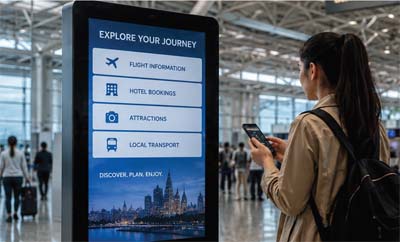 For businesses such as ours, AI will create another major technology cycle. If you look at its positive side, the opportunities are immense. A digital voice agent can already speak with a customer almost as effectively as a human agent, including in local languages. It can understand context, sentiment and emotion, and the technology is being refined continuously.
Could it be disruptive? Certainly. Some levels of work and some categories of jobs may change. But many new opportunities will also emerge around the technology.
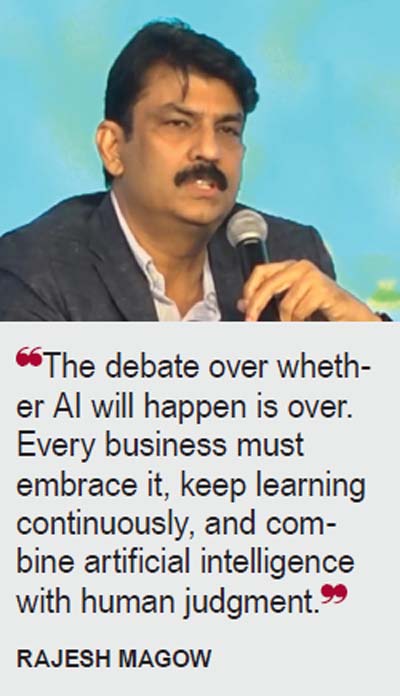
My message is that we should come out of the debate over whether AI is happening. We must move beyond denial and embrace it sooner rather than later. It is going to become part of everyday life. Every business, whether technology-led or brick-and-mortar, will have to recognise that cycle and adapt.
Aashish Gupta: In a service business, technology matters, but people matter just as much. How does MakeMyTrip encourage continuous learning across the organisation?
Rajesh Magow: Without constant learning, an individual cannot evolve and an organisation cannot evolve. That is fundamental. Learning must be continuous, and it can come from anyone. The important thing is to keep your mind open and remain willing to change.
At MakeMyTrip, part of the learning happens by force because technology keeps shifting. You first have to see the change early, understand its implications for your business, and then begin learning, skilling and reskilling the workforce.
But there is another dimension. As more first-level or routine tasks are handled through tools, what will not be replaced is judgment. Someone still has to take the call. Human intelligence has to sit on top of artificial intelligence. Tools can enable you and improve the quality and speed of decisions, but when you run a business, you still have to use your instinct, experience and intuition.
 We have classroom programmes, leadership development initiatives and formal training, but we try to build a culture in which people are not dependent entirely on the HR department to arrange their learning. Learning is first for the individual and only then for the organisation.
I often ask colleagues a simple question. We spend a significant part of our disposable income on dining, travel and other experiences. How many of us consciously spend money from our own pocket on upgrading our knowledge? We read, of course, but very few people create an annual budget for learning.
In the corporate world, it becomes easy to say that the company did not arrange a programme or that a department did not train us. But even if the company trains you, will you truly learn? The responsibility ultimately belongs to you. Once people make that shift, they begin to value learning at least as much as the other experiences on which they willingly spend.
Aashish Gupta: Every institution eventually has to think about succession. What would you look for in the person who follows you?
Rajesh Magow: I would not describe anyone as the next Rajesh. It could be a man or a woman, but whoever it is must be themselves. Every individual brings a different set of capabilities, skills, operating style and vision. It is unfair to expect one leader to become a replica of another.
Succession is a natural responsibility of every organisation with good governance. Deep and I worked together for many years, and over time he moved into a non-executive role. That was a natural transition. It does not mean he is disconnected. MakeMyTrip is his baby, and he continues to remain involved at different levels.
The same principle will apply in the future. The process has to be smooth, organised and non-disruptive. A listed company carries a tremendous responsibility to its shareholders, employees, partners and customers, so leadership transitions cannot be casual or improvised.
We are still a young company. There are many institutions in the hospitality and travel sector that are much older and have managed several generations of leadership. We can learn from them. When the time comes, the transition will happen naturally, and the person taking over will bring his or her own strengths rather than trying to become someone else.
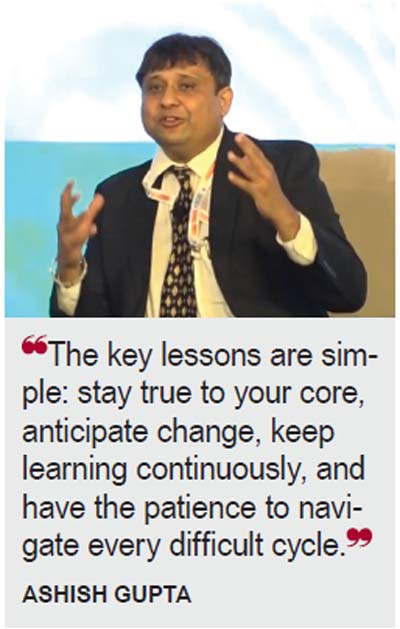
Aashish Gupta: There are several clear lessons in that journey: stay true to the core, anticipate change, keep learning and have the patience to ride through difficult cycles. Thank you, Rajesh, for sharing the MakeMyTrip story so candidly.