
Over 50 years of Tourism Advocacy
Building India's Travel Businesses
Lucknow Unveiled, Re-Read.

In an era of global heritage commodification, Lucknow’s rich Western–Oriental fabric exemplifies cultural sustainability by embracing complexity. As cities face the challenge of balancing tourism with authentic preservation, Lucknow’s story emphasises that genuine heritage tourism should be interpretive, dialogic, and grounded in the voices of tradition bearers.
Opening the City Like a Palimpsest
To approach Lucknow is to step into a city already folded in memory, already stitched into the fabric of received stories. The familiar script unfolds: the opulent theatre of the Persian Nawabs, their saffron-scented kitchens, the whisper of chikankari under moonlight, the monumental silence of Imambaras. Another thread follows, the bruised memory of 1857, the British mutiny, the blood-stained gardens of revolt.
But to read the city like this is to flatten it. Lucknow is not a single note sung in a long hall. It is a layered song, a fabric woven from threads both visible and hidden, from the East and the West, from the Nawabi and the European, from the sacred ritual and the secular spectacle. To truly perceive Lucknow, one must unlearn the stereotype and learn instead to layer the city with new lenses—historical, sensory, critical.
Awadh: The Principality That Became a Courtly Dream
When the Mughal Empire began to wane in the eighteenth century, Awadh rose like a新 moon in northern India. Its capital, Lucknow, became the stage on which the Nawabs, Persianate in origin yet rooted in Indian soil, reimagined power not through the sword alone but through architecture, urban form, and the quiet seduction of refined lifestyles.
The Nawabi city was not a vertical monument piercing the sky. It was a horizontal expanse of palaces, gardens, markets, and ceremonial gateways spreading like a carpet across the land. This cadence mirrors the late Baroque courts of eighteenth-century Europe, where exuberance and grandeur defied the austerity of Protestant reform. In Lucknow, the Nawabi aesthetic embraced the same spectacle, the same ornament, translating a European spirit into a local language of form.
The Imambara: Where Sacred Spectacle Breaths
The Imambara is not merely a building; it is a performative space, a congregational hall where Shia Muslims gather to mark mourning rituals during Moharram. These structures create interiors of awe, of collective breath, of ritual drama. In Lucknow, the Imambaras stand as monumental nodes in the urban fabric, their scale and gajkari stucco ornamentation reinforcing the courtly investment in spectacle and sacred beauty.
Objects That Travelled: Birmingham Glass, Belgian Mirrors, Wedgwood and the Rococo Whisper
The wealth of the Nawabi court drew Europeans, and their objects entered Lucknow’s interiors with immediacy, with prestige. Glassware from Birmingham’s F&C Osler became a defining material in religious and domestic spaces. These designs were associated with exotic Eastern otherness, yet embraced as markers of taste. In 1874, Osler created the famed glass fountain for the Maharaja of Patiala; the Nawabs of Lucknow used Osler glassware and mirrors from Belgium in both sacred and domestic settings.
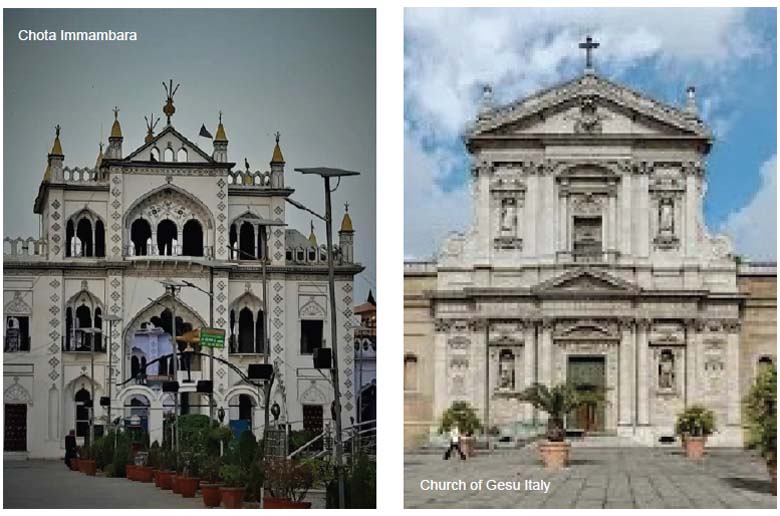
Rococo tendencies, curvilinear ornament, sculpted mouldings, dramatic effects that invoke surprise and movement, entered Lucknow’s architectural vocabulary. These tendencies resonate in the gajkari stucco and the ornamental gateways that punctuate the city.
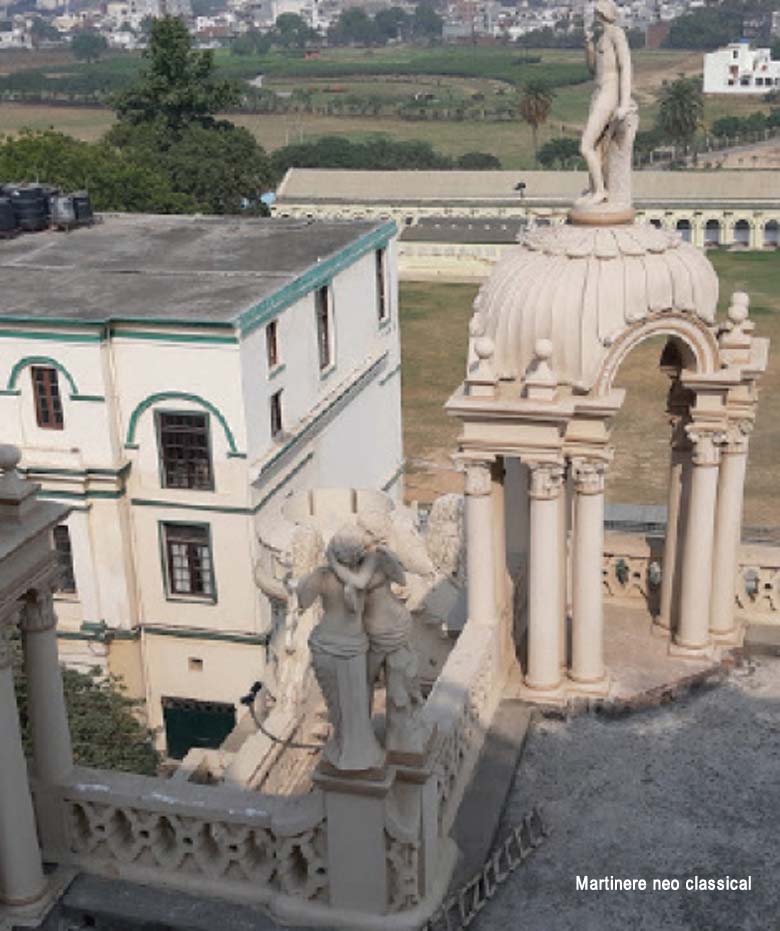
Wedgwood ceramics, introduced by the English master Josiah Wedgwood, brought a neoclassical idiom: pastel backgrounds with uplifted mouldings of figures from Classical Greek–Roman myths. Wedgwood creamware became the favourite of European royalty and the upper classes and made its way into Lucknow. These objects appear in Nawabi interiors at Constantia (now La Martinière College), where elaborate Jasper and other varieties of Wedgwood designs adorn the building alongside Baroque towers and Neo-Classical rhythms.
Claude Martin: The French Renaissance Man of Lucknow
 Claude Martin was an eighteenth-century Frenchman who traversed Indian soil in varying capacities, accumulating wealth and power while forging a trusted alignment with the Nawabs of Lucknow, where he lived and died. Rossie Llewellyn-Jones have painstakingly penned his history. Martin was a Renaissance man, interested in hot-air balloons, puppet theatre, art collections, and libraries. He built elaborate buildings, funded the Nawabs, and embedded himself in the city’s cultural and architectural life.
Constantia, his mausoleum, is now La Martinière boys’ school. The building boasts Baroque towers, Neo-Classical rhythms in facades, Greek–Roman statues of Muses, and elaborate Jasper and other varieties of Wedgwood designs. It is a monument to cosmopolitan experimentation and to the Nawabi-Western synthesis that shaped Lucknow’s identity.
Freemasonry and the Architectural Metaphors in Lucknow
The Freemason movement emerged as a secret fraternal assembly in the seventeenth and eighteenth centuries, drawing intellectuals, politicians, philosophers, professionals, and artists into a network organised around lodges. Past members include Oscar Wilde, Henry Ford, Winston Churchill, Mozart, and George Washington. Today, over five million Freemasons believe that God is the Great Architect of the Universe and use architectural and geometric symbolism, the square and the compass, in their rituals.
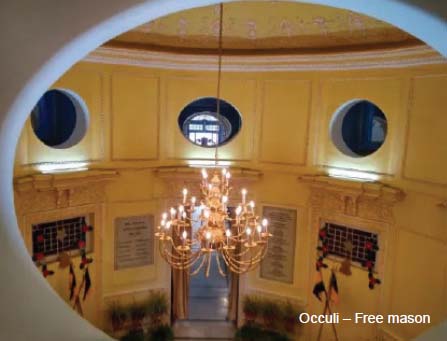
 Claude Martin appears to have been influenced by the architectural ideas of the Freemasons. The architectural metaphors of Freemasonry emphasise visual grandeur and the dramatic effects of perspective and revelation. In Lucknow, the presence of oval openings called oculi at La Martinière School reflects geometry at play and creates a theatrical effect, revealing beckoning worlds beyond. The repeated evidence of oculi communicating a narrative of visual spectacle and movement links Claude Martin to Freemason thinking.
European design, such as Baroque architectural features, twisted columns, and dramatic effects of space and light, is evident in palace complexes like Farhat Bagh and in buildings like Dilkusha Kothi, built under Nawab Saadat Ali Khan. It was intended to be a hunting lodge but later used as a summer home. The building, surrounded by forest, has an extended garden. It was in the grounds of the Baroque building of Dilkusha that Claude Martin launched his hot balloon venture.
Gardens became laboratories for botanical resources, linked to Kew Gardens in London, as in Lal Bagh Garden in Bangalore. Nawab Saadat Ali Khan established the Royal Garden, which later became the National Botanic Institute.
Baroque Spatiality: The Choreography of Light and Movement
Baroque spatiality refers to the orchestration of space to produce theatrical effects of perspective, light, and movement. It emphasises visual grandness and dramatic revelation. In Lucknow, Baroque spatiality is evident in palace complexes like Farhat Bagh and in buildings such as Dilkusha Kothi. The interplay of space and light creates a sense of unfolding spectacle, inviting the viewer into a choreographed experience.
Post-1857: The Colonial Reordering of Lucknow
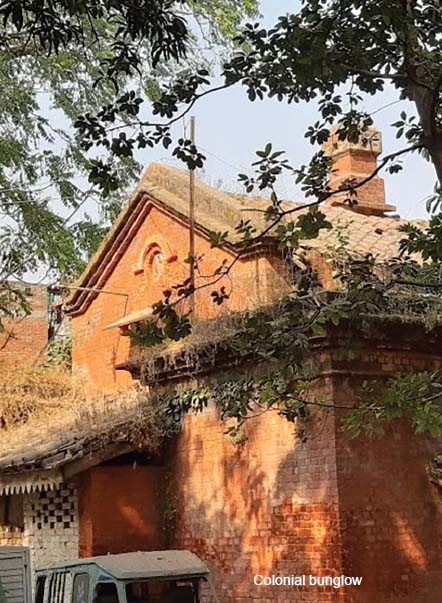
After 1857, the British sought to make Lucknow “safe, hygienic and clean.” This led to the expansion of Cantonments in Lucknow, Kanpur, and Meerut, integrating Bungalow architecture for civilians. The Bungalow served as a British suburban villa, marked by classical detailing, large lawns, stables, pitched roofs and high ceilings. In Delhi, bungalows featured Tuscan columns, symbolising the might of the British Empire. Tuscan columns are defined by simplicity and a stoic essence that communicate power; their shafts, bases, and capitals remain unadorned.
Neo-Nawabs: The Hybrid Lifestyle of Conspicuous Consumption
The Neo-Nawabs—loyal landed elites cultivated by the British post the revolt of 1857, often not aligned with the erstwhile Persian Nawabs acquired homes around Kaiser Bagh, the palatial complex laid out by Wajid Ali Shah, the last Nawab of Lucknow. Families acquired crests; many came to be called Raja, regardless of whether they were Muslim or Hindu. Some were invited to the Princes’ Chamber in Delhi; others received honours, titles, medals.
Like their predecessors, the Neo-Nawabs pursued conspicuous consumption. Their lifestyle combined Oriental lavishness with Western tastes: entertainment, acquired etiquette, mannerisms, and Western cultural nuances, including furniture, interiors, and landscaped gardens.
The 1920s and Beyond: Western Leisure and Hazrat Ganj
In the first half of the twentieth century, elites and middle-class sections in Lucknow, Delhi, Calcutta, Bangalore, including Anglo-Indians, participated in Western leisure: clubs, coffee houses, ballroom and dance music via gramophone and radio.
The Cantonment expanded; just before the Second World War, Lucknow was strategically important due to fears of Japanese bombing in Calcutta. Allied Eastern Command moved inland. Hazrat Ganj became the fashionable marketplace providing European goods and services.
Walter Burley Griffin and Marion Mahony Griffin: Architects of Confluence
Walter Burley Griffin and Marion Mahony Griffin, American husband-and-wife architects, arrived in Lucknow in 1935. Walter Griffin designed Canberra. Griffin spent his last 15 months in Lucknow, where he died and was buried. His enchantment with the Orient and training in progressive architecture led him to create a vocabulary of confluence.
He designed the Tagore Library at Lucknow University, the Zenana quarters in Raja Jehangirabad’s palace, and, through his bond with the House of Mahmudabad, a library and projects in Ahmedabad.
Jehangirabad House: Tiles, Fibonacci, and the Stately Interior
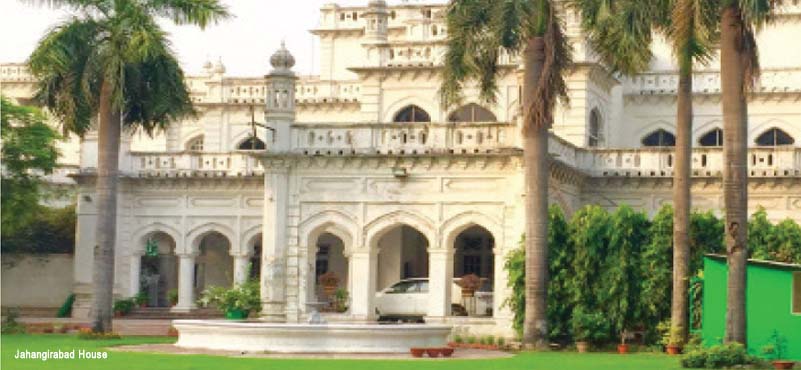
Jehangirabad House stands in Hazrat Ganj, built by Griffin for the Raja. It is a majestic reminder of Nawabi-British days. Photographs speak of the family’s connection with Mughal Royals and high society that hosted Jackie Kennedy.
A family note describes: “The exterior of the palace is symmetrical.” The building reflects Mughal architecture combined with Awadh identity, domes, and ornate floral motifs.
The interior plan follows the Fibonacci principle, a mathematical sequence in which the sum of two preceding numbers equals the next: 0, 1 becomes 1; 1, 2 becomes 3; 2, 3 becomes 5. This sequential pattern shapes the interior layout, creating open spaces and intriguing perspectives of a journey within a home.
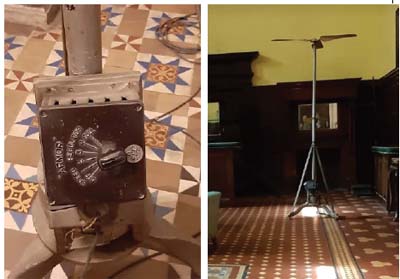
The interiors conflate Oriental and European elements. Tile flooring from Sindh looks like a carpeted floor. Edwardian furniture and Osier lampshades of ships convey stately character. The drawing room has charming patio spaces and walls adorned with miniature paintings, and personal links that convey the high-flying lifestyle of Lucknow’s landed aristocrats.
Three fans stand independently on poles. Produced by the American General Electric Company, the fans have three inverted blades and direct current. Such fans are also found in the Old Indian Parliament House in Delhi.
Lucknow’s Present Tourism Challenge: Between Spectacle and Substance
Lucknow’s present tourism challenge lies in the tension between spectacle and substance. The city is often offered to visitors through a familiar vocabulary of Nawabi elegance, cuisine, chikankari, and monumental splendour, yet its deeper cultural life resists such easy packaging. Its heritage is not confined to buildings; it lives in thresholds, bazaars, performance traditions, riverfronts, rituals, crafts, and forms of social refinement that require careful interpretation. This also calls for upgrading the skills of those who curate and mediate the city’s heritage tourism, drawing on new global literature and critical approaches, such as those discussed in Exhibiting India, where heritage is understood not merely as display but as interpretation, dialogue, and public pedagogy. The danger, therefore, is not simply neglect, but simplification: a city of layered histories reduced to consumable images. For Lucknow, the task ahead is to protect the fragile material fabric of its past while allowing its living, plural, and sometimes contradictory cultural worlds to remain visible.
The Western Thread Remains: Conservation, Heritage, and the Living City
The Western thread represented in the Anglo-Indian lifestyle lives on in the environment of La Martinière School, the Ram Advani Bookshop, and elsewhere. New globalised shops are emerging in Hazrat Ganj Market; tucked into corners are new spaces like Cherry Tree Café in the famed Habibullah Estate.
Tourism narratives have the potential to expand by incorporating multiple layers, such as Western designs and lifestyles. What remains vital is allowing tradition bearers such as the Nawab of Jehangirabad and Mahmoodabad to conserve their heritage, sustain, and retain echoes of the city’s character, the Constantinople of the East, not monochrome but rich and a delight for an explorer who sets out to relish their senses.
Lucknow endures not as a static relic but as a living, shifting aesthetic world. To read it is to walk its thresholds, to listen to its bazaars, to witness its rituals, to feel its riverfront breath. It is a city of layered continuities, of silk-woven tissues where Western threads knot into Oriental refinement, where every corner holds a story waiting to be unspooled.
Lucknow is not a postcard of Nawabi nostalgia; it is a living weave of East and West, where every stone, tile, and fan hums the song of a city that, in embracing its heritage, became a timeless destination for tourism.
ABOUT THE AUTHOR
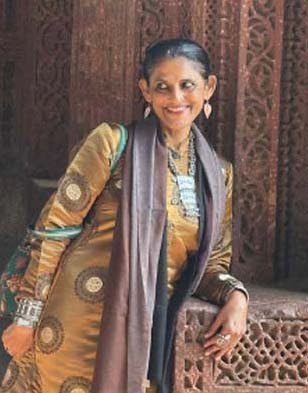
Dr. Navina Jafa is a cultural strategist, sustainability advocate and Kathak dancer blending heritage, tourism and community knowledge to shape resilient, innovative and sustainable futures.