
Over 50 years of Tourism Advocacy
Building India's Travel Businesses
Heritage Tourism Beyond Monuments: The Houses Where History Lives

A Door that Opens to the Past
More than two decades ago, during a training course at the Royal School of Military Engineering in Chatham, England, I spent a free Sunday exploring the nearby Medway towns. It was one of those unplanned excursions that travellers often remember long after more carefully arranged journeys have faded from memory.
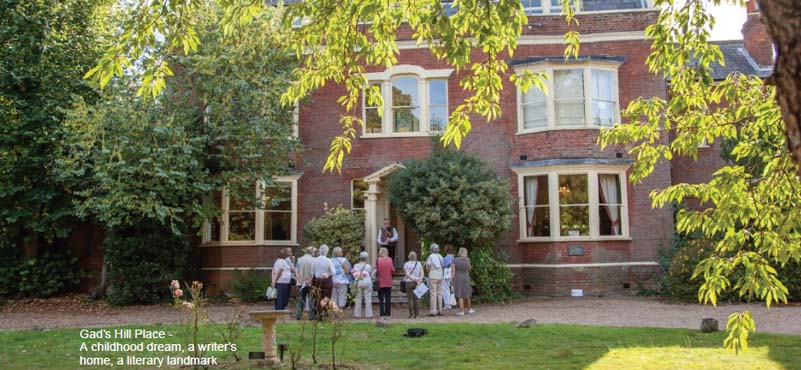
As I wandered through the historic streets, someone pointed out a house associated with Charles Dickens. At first glance, it appeared to be just another elegant English residence. Yet the story attached to it transformed the building entirely.
As a young boy living in the area, Dickens would often walk past a handsome Georgian house called Gad’s Hill Place. On one such walk, his father reportedly told him that if he worked hard enough, perhaps one day he might own a house like that. The remark lodged itself in the imagination of the young Dickens. Thirty-five years later, after becoming one of the most celebrated writers in the English-speaking world, he purchased the very same house. There he spent the final years of his life, writing portions of Great Expectations and A Tale of Two Cities. There too, in 1870, he died.
Standing outside that house, I realised that visitors were not coming merely to see bricks and mortar. They were coming to encounter a story. The building had become a bridge between literature, memory and place.
Years later, while walking through the corridors of Braganza House in Goa, that memory unexpectedly returned. Once again, it was not architecture alone that held my attention. It was the realisation that a house can preserve something larger than itself—a personality, an era, a dream, even a fragment of a civilization.
That experience led me to a simple question: could India’s future tourism story lie not only in its monuments and landscapes, but also in the preservation of the homes where its ideas, art and history were shaped?
The Power of Domestic History
Monuments inspire awe. Forts speak of power. Palaces reflect wealth. Temples evoke devotion. But houses tell a different story altogether.
A house reveals how people actually lived. It contains traces of ordinary routines and extraordinary moments. It preserves the spaces where conversations took place, where books were written, where aspirations were nurtured and where decisions were made.
A study table, a favourite chair, a family courtyard, a veranda overlooking a street—these details may seem insignificant, yet they often provide a more intimate understanding of history than any monument can offer.
When visitors enter a preserved historic house, they do not simply observe the past. They step into it. The experience becomes personal. History ceases to be an abstraction and becomes human.
That is why the homes of writers, artists, scientists and reformers possess such unique cultural value. They allow us to encounter greatness not in its public form but in its private setting.
Homes Where Ideas Were Born
Many of the ideas that shaped India emerged not in grand institutions but in ordinary homes.
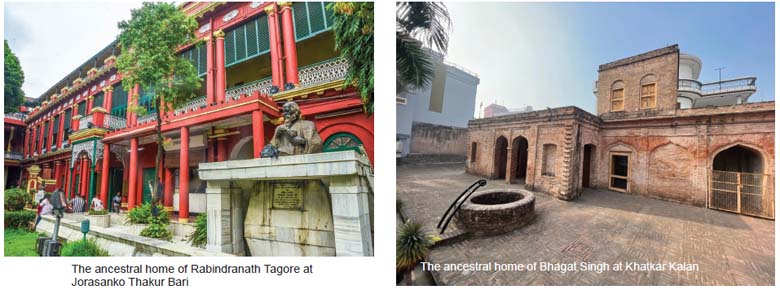
The ancestral residence of Rabindranath Tagore in Kolkata witnessed the intellectual ferment of the Bengal Renaissance. The modest environment in which Premchand lived inspired stories that continue to illuminate the realities of Indian society. The ancestral home of Bhagat Singh preserves memories of a young revolutionary whose courage continues to inspire generations.
These places matter because they remind us that history is not made only in parliaments, battlefields or courts. It is also made in studies, courtyards and family rooms. The poems that stirred a nation, the novels that transformed social consciousness and the ideas that fuelled political movements often emerged from quiet domestic spaces.
Civilizations are shaped as much by thinkers as by rulers, and the homes of thinkers deserve the same attention that we routinely give to monuments of power.
Unfortunately, while India has preserved many of its forts and temples, it has often neglected the houses where some of its most influential minds lived and worked.
The Forgotten Houses of India
Across the country, countless historic homes are slowly disappearing.
Some have fallen into disrepair. Others have been demolished to make way for modern development. Many survive only in fading photographs and family memories.
Every such loss represents more than the disappearance of a building. It is the disappearance of context. When a historic house vanishes, we lose the opportunity to understand the environment that shaped a remarkable individual. We lose architectural traditions, family stories, personal artefacts and tangible links to the past.
In a rapidly urbanising country, this loss often goes unnoticed. Economic pressures understandably favour redevelopment. Yet once a historic home is destroyed, it can never truly be recreated.
A nation that neglects its domestic heritage risks reducing its history to dates and events while losing the human spaces where that history was actually lived.
When Houses Become Destinations
The enduring appeal of Gad’s Hill Place offers an important lesson.
 People do not visit the house because it is the grandest building in England. They visit because they know who lived there, what he achieved there and why his story matters. The building itself is only the vessel. The story is the destination.
This principle explains why historic homes across the world continue to attract visitors. Whether associated with writers, artists, scientists or statesmen, these houses provide an experience that museums often struggle to replicate.
Visitors are not merely looking at objects. They are seeking connection. They want to stand where a great writer stood. They want to see the room where an important idea emerged. They want to experience history through proximity rather than through display panels.
The success of such places demonstrates that tourism increasingly thrives on authenticity. Modern travellers are searching for stories, not just sights. Historic houses provide exactly that.
A Hidden Indian Model: Goa
Interestingly, India already possesses an outstanding example of this approach. It exists quietly in Goa.
Beyond the beaches, churches and resorts lies a remarkable world of preserved ancestral homes that offer visitors an intimate encounter with history.
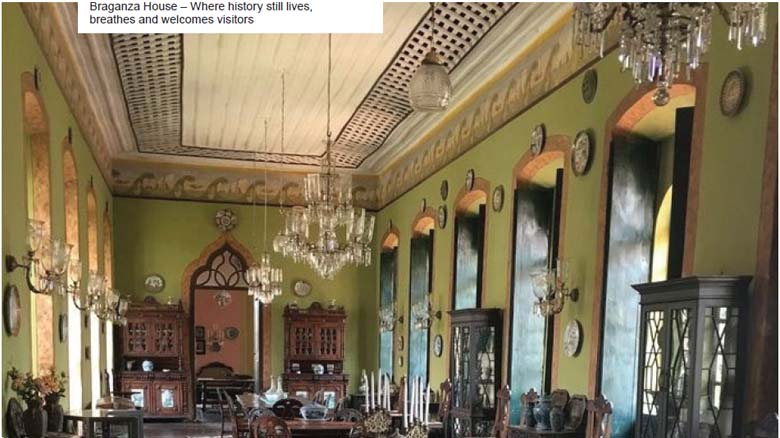
Among the most celebrated is Braganza House in Chandor, a magnificent Portuguese-era mansion that remains one of the finest surviving examples of domestic heritage in India. Walking through its rooms is unlike visiting a conventional museum. The antique furniture, chandeliers, portraits and family artefacts create the impression that history has merely stepped aside for a moment and may return at any time.
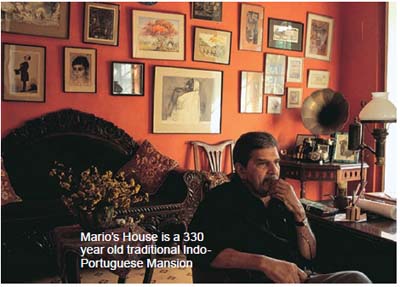
Equally fascinating is the ancestral home of Mario Miranda in Loutolim. More than four centuries old, the house represents not merely architectural continuity but cultural continuity. It evokes the environment that shaped one of India’s most beloved cartoonists, whose illustrations captured the humour, warmth and everyday rhythms of Goan life.
What makes these places special is not simply their age. It is their authenticity. These are not reconstructed experiences. They are living repositories of memory.
Goa has, perhaps unintentionally, demonstrated a model of heritage tourism that deserves national attention. It shows how homes can become cultural destinations without losing their character or dignity.
A New Idea: The Houses of Indian Civilization
Imagine if this idea were expanded across India. Every major city possesses houses associated with writers, artists, freedom fighters, scientists, philosophers and social reformers.
Many remain neglected. Some are barely known beyond local communities. What if they were identified, restored and connected through a national network? Visitors could explore literary trails, freedom movement circuits, artistic neighbourhoods and scientific heritage routes.
A traveller visiting Kolkata might encounter the world of Tagore. A visitor to Varanasi could experience the environment that shaped Premchand. Punjab could offer deeper engagement with the life of Bhagat Singh. Countless other cities could tell equally compelling stories.
Such a network could be called “The Houses of Indian Civilization.” Its purpose would not merely be preservation. It would be storytelling.
Each house would become a doorway into a larger narrative about India’s intellectual and cultural evolution.
Cities as Museums of Memory
The benefits of such an approach would extend far beyond tourism. Historic homes create anchors of identity within rapidly changing cities.
They encourage local pride. They support educational programmes. They attract cultural travellers who typically spend more time and engage more deeply with destinations. Most importantly, they help cities remember themselves.
Modern urban development often produces landscapes that look increasingly similar. Historic houses provide uniqueness. They preserve the distinctive stories that differentiate one city from another.
Imagine students visiting the home of a poet instead of merely reading about him. Imagine writers finding inspiration in the rooms where earlier generations worked. Imagine neighbourhoods rediscovering forgotten chapters of their own history.
In such a vision, cities cease to be collections of buildings and become museums of memory.
The Quiet Rooms Where a Nation Was Dreamed
Travel often leads us toward spectacular monuments. We climb ancient forts, admire magnificent temples and marvel at royal palaces.
These places deserve their fame. Yet some of the most meaningful journeys begin with something much simpler: a doorway. A doorway into a house where a writer dreamed of a different future. A courtyard where ideas were debated. A study where books were written. A veranda where a young revolutionary imagined freedom.
Charles Dickens fulfilled a childhood dream when he finally entered Gad’s Hill Place as its owner. More than a century later, visitors still come because the dream survived the man.
India possesses thousands of similar stories waiting behind ageing doors and fading walls. The homes of poets, artists, scientists, reformers and freedom fighters remain scattered across the country, often overlooked despite their immense cultural value.
If preserved thoughtfully, these houses could become a new frontier of heritage tourism—one built not on spectacle but on memory. For monuments tell us what a civilization achieved. Houses tell us how it lived. And perhaps the future of tourism in India lies not only in its grand monuments, but also in the quiet rooms where its soul was imagined.
The building is the vessel, but the story is the destination.
ABOUT THE AUTHOR
Lt Gen Rajeev Chaudhry (Retd) is a social observer and writes on contemporary national and international issues, strategic implications of infrastructure development towards national power, geo-moral dimension of international relations and leadership nuances in changing social construct.