
Over 50 years of Tourism Advocacy
Building India's Travel Businesses
Hospitality has a Unique Trickle down Effect on the Entire Eco-system

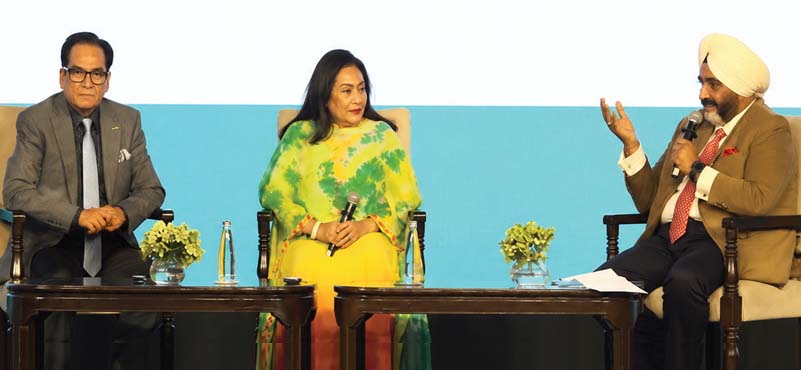
Mandeep Singh, president, HVS in conversation with Dr Jyotsana Suri, chairperson, Lalit Group of Hotels and KB Kachru, chairman, Radisson Hotels, india and South Asia.
Every traveler may arrive because of a destination but it is hospitality as the Honorable Chief Minister just mentioned that shapes the experience and leaves a lasting impression. As India’s tourism ambitions continue to grow, the hospitality sector is entering an exciting new phase, one defined by expanding markets, changing traveler expectations, sustainability, technology and world class service. What does the next frontier look like? Let’s hear from the leaders who are helping define this. On our panel, Mr. K. B. Kachru, President of the Hotel Association of India and Chairman of the South Asia Radisson Hotel Group, one of the towering figures of Indian hospitality. Over a distinguished career spanning more than four decades, he has helped shape the industry’s evolution, mentored, generations of hospitality professionals and has been a consistent voice for policies that have strengthened tourism and hospitality in India. Dr. Kachru, may I request you to please come up. Joining him is Dr. Jyotsna Suri, Chairperson and Managing Director of the Lalit Suri Hospitality Group. She’s been one of the pioneering forces behind India’s luxury hospitality sector, and under her leadership, the Lalith has grown into one of India’s most respected hotel brands, while her contribution to tourism has earned her national and international recognition. Guiding this conversation is Mr. Mandeep Lamba, President and CEO, South Asia HVS, one of the region’s most respected hospitality consultants. With more than three decades of leadership across hotel operations, ownership and advisory, he brings a unique perspective on the trends shaping the future of hospitality. May I request everyone to please be seated. You can have your conversations while you’re seated. Please sit down. Thank you.
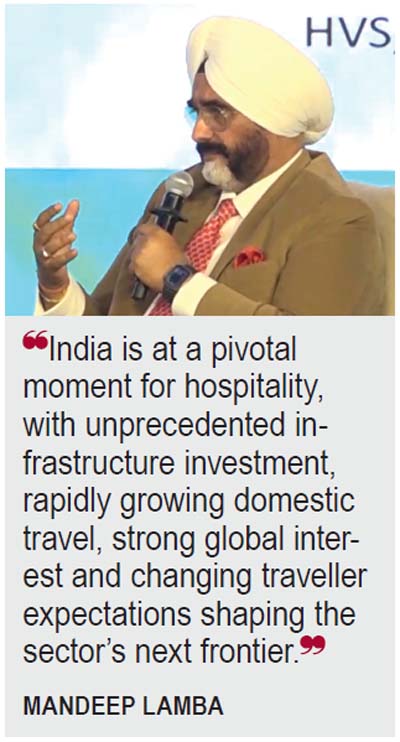
Mandeep Lamba: Thank you so much, Rini. Very good afternoon, ladies and gentlemen. We’re running a little late, so we’ll try and make this as quick as possible. I am absolutely delighted to be here hosting this special session of the next frontier of hospitality. It comes at a time for the, you know, at a very pivotal time for the hospitality sector when we’re seeing unprecedented investments in infrastructure. We’re seeing domestic travel really take a leap forward.
 We’re seeing a lot of global interest in India and we’re seeing some changing expectations from the traveler. And who better to discuss this than with two of the most respected leaders from the hospitality sector who have shaped the evolution of this sector for several decades. But today is not about looking at the past. Today is about looking at the future. So we’re going to talk to both of them to sort of understand where our sector is sort of heading and what we need to do to probably make it shine even better. I’m going to start with you, Dr. Suri.
We know that hospitality and tourism contributes to GDP, to employment, to investments, etc. But what’s that one contribution you think is the most significant and which probably is underappreciated?
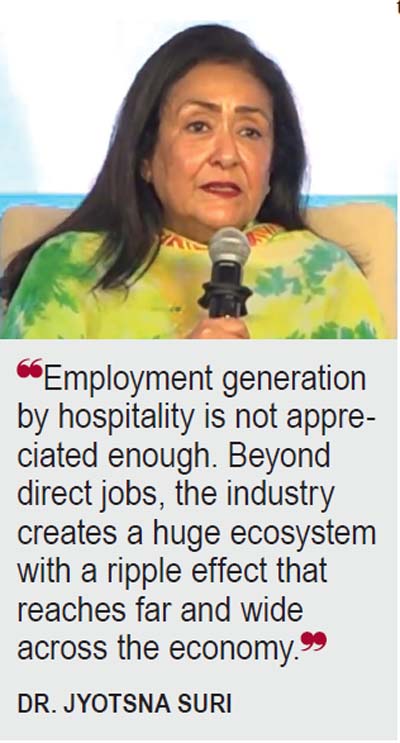
Jyotsana Suri: Namaskar to all of you and thank you, Faith, for having us here. Thank you, Mandeep, for that very, very important question. I would say that straight away it’s employment. The employment generation that this sector actually does is not appreciated at all. And I’m not talking about direct employment alone.
I’m talking about direct and indirect. and the ecosystem, I mean this industry creates such a huge ecosystem, the ripple effect is so far and wide so the one sector that is underappreciated and should be brought to the forefront is the contribution to employment.
Mandeep lamba: I couldn’t agree more but I’m going to ask you the same question Mr. Kachru and get your view on this as well.
 K B Kachru: Mandeep, I think we heard this morning and yesterday almost there is one vision, one strategy and the same history. I think we need to acknowledge that our industry is not really positioned where it should be. It’s not appreciated. The key word you mentioned was not appreciated is look, if we are accepted as one of the largest employers providing employment which is so important in India, We are contributing hugely to the national GDP. Why are we not accepted as an industry? Why aren’t we being helped to position our industry right internationally?
We need people. Everybody is talking about infrastructure. You know, government has done a great job in terms of doing basic infrastructure as airports, roads, connectivity to an extent, although last mile connectivity is still an issue, but we want more investment. I think we are all surprised that when everybody is talking about foreign investment in India, In our hospitality trade, last year I think it was close to about $560 million. It’s really, really nowhere. Total of $560 million came to our industry.
Out of that, only 40 % actually came from institutional and P. The rest was H &I investment. Now have we asked ourselves why aren’t we getting these investments. Why aren’t we making more hotels, last mile connectivity, helping provide more infrastructure for tourism? The reason is we are not acknowledging what is wrong with us. I think we have to be optimistic. We have everything.
We have culture, we have monuments, we have food, we have everything with us. But are we channelizing, creating a package? I think that’s really not appreciated. Overall everybody says tourism is a pillar of economy but we have to do something to make it really a huge pillar for economy.
Mandeep Lamba: You sort of prompted me to my next question. Mr. Kachru, is that there seems to be a huge amount of global interest in India. I was at the New York Conference very recently, Hospitality Conference and all the five global CEOs who were sitting on a panel discussion spoke in a 45 -minute session, they spoke 35 minutes about India and how India is going to be the next biggest growth story for hospitality. Having said that, I’m coming back to what you said, we still have very, very low penetration in branded hotel rooms and even the investments coming like you alluded are limited at this moment in time. What is it that we can do to get this going in a more sort of scalable fashion or what is it that the government needs to do and what is it that the private sector needs to do to get this going?
 K B Kachru: I think one big thing what has happened is we have all accepted that Over 50 % of the GDP comes from Tier 2 and Tier 3 towns. And as Puneet said yesterday that I am not here talking about the brand I work for, but I think we were one of the first ones to acknowledge that this would happen to India in 10 years. And everyone here has to acknowledge that Tier 2 and Tier 3 towns would drive our economy between 55 and 60 percent. Now what is to be done is last mile connectivity, talent. I would like Dr. Suri because she is actually hugely involved in talent development. Government is doing a lot through skill council and all brands, every hotel company is doing the same thing.
But she has taken some fantastic initiatives and HAI with her have also contributed a little bit.
Mandeep Lamba: So it brings me to my question to Dr. Suri. You know there is, I mean we can all clearly visualize the growth of the sector and it seems to be at a rapid trajectory going forward over the next I would think 10 to 15 years. It is going to be India’s hospitality moment. But what we all seem to be struggling with to a larger extent is to find talent to service this growth that we are anticipating. Two questions from you, Dr. Suri. First, what do you think we can do to attract more talent into this sector?
Mandeep Lamba: It seems to be we are finding it hard to do so as we speak. So what is it that we can do? And then the second question for you, you’ve been championing the cause of diversity and inclusion not only in your own hotel company but also in the larger sector and you’ve been doing some amazing human work in that field. So let’s talk a little bit about both these points please.
 Jyotsana Suri: So it’s quite an anomaly you know that while we all know that this industry generates the maximum jobs and At the same time, we’re all struggling to get the right talent. And this is coming clearly from the fact that people are not wanting to become part of this industry. So there’s still that mindset, you know, that you want to become an IAS officer or an engineer or a doctor or now an AI, you know, technology person. There isn’t that hunger. or that interest in joining the hospitality industry. Now this could be a little bit of our own fault because we haven’t spoken enough about it.
So I think the first thing that we need to do to answer your first question and that is how do we generate this interest. It is for all of us, every member of this industry and we do need the support of the government as well. We’ve got to go out to a massive advertising campaign. I mean you see advertising for almost all sectors. the army included. I think time for us to have a massive advertising, you know, push to encourage people to join the industry, where we showcase the positives of the industry.
Somehow it seems to be, okay, the last choice that I have, it is of course, we have to understand that ours is a 24 hour, 365 days industry and it’s an industry that never sleeps. You know, while everybody else is doing a Monday to Friday and all manufacturing is doing that, we are not. But that itself gives us an opportunity. So where you would be employing 20, you are now employing 40 because you are running the segment all around. So advertising and changing the mindset of people. The other thing that we are not doing correctly and that’s answering your second question is we should not be picky and choosy.
And therefore, for us, for example, all the marginalized communities, we’ve reached out to all of them. And we are getting so much talent from them, Mandeep. I’m so proud to share with you that we’ve got 200 transgenders working for us.
And they go across all our hotels and they go across all categories. So it’s not that they are just in one place. We’re not keeping them behind. We’re bringing them in. to the front. We’ve got 25 young girls who have fought the war for acid.
It’s unfortunate, but you don’t get a boy who’s been in an acid attack, you know, somebody who’s given, he’s gone through it. It’s always girls. We have those girls. And by the way, they are in the front of the office. They are not behind. We’ve got LGBTQI plus community working for us, differently abled.
They area challenged but you know all of them have some capability. So we are we are honing those capabilities and at this point of time we’ve got more than 2 ,000 people working across this entire segment. What are we getting from it? We’re getting fabulous loyalty and the dedication that these people have. They say, God takes something and gives something. In logon ke paas wo loyalty aur wo dedication hai and we should take advantage of it and I also want to share with you while all of us are sitting here is that a lot of hotel companies are doing it now and that for me is a moment of great pride.
Just to add a little bit to what KB mentioned about the hospitality school. So in this hospitality school we’ve just joined hands with HAI and we’re trying to cover every aspect. So you, this is not about skilling. This is already people who are skilled but because they come from such diverse backgrounds, they may not have the right interpersonal skills. How do they present themselves? How do they speak to the guests?
So we’ve started that and I must say that we’re meeting a lot of success with that as well. We’ve tied up with IHMs and a lot of my other colleagues in the industry are also doing that where they’re going out and training in IHMs and so I think they’re doing a good job but we need to push it a little more.
 Mandeep Lamba: That’s absolutely wonderful. Ladies and gentlemen, I’d request you for another big round of applause for its difficult work, very rewarding though from everyone that I’ve spoken to who has made that attempt to work with diverse communities. Everyone says it’s extremely rewarding. It may be a little difficult to sort of get into it. Mr. Kachru, quickly, I think we’ve got limited time. You know, for any growing sector, large sector like ours, hospitality, there’s always an institution that you need that sort of supports and builds, you know, the sector.
HAI has been one such institution which has worked on advocacy and worked with the government in sort of helping behind the channels, behind the scenes on several fronts. I’d love to hear from you in those many years that HAI has been sort of supporting the sector. What do you think would be one or two of your large contributions which you found have worked or have been successful?
K B Kachru: You know, I must first of all give credit to FAITH and all the verticals of FAITH who have one objective and we are following that very strictly. We, I don’t know, a lot of you would remember, each of our organizations used to go to the government with a separate laundry list. And I remember one minister telling me, you know, there are 10 people and everyone has 20 -20 points. You tell us what is important. So a lot of us got together and prepared a common list. which is, what do we want?
What’s our vision? And what we are asking our government is, please walk the talk. We initiated certain key priorities for ourselves, like our faith president said yesterday, infrastructure. I mean, we know we want foreign investment. What are we doing for it? How do we get foreign investment?
How do we prepare for infrastructure? You mentioned to me that get more branded rooms. Yes, we want branded rooms. India today has close to only 200 ,000 branded rooms. one state of United States has more than the whole of India has in branded rooms. But how do investors come?
They need to be incentivized. We should have ease of doing business. We should remove any friction. which is delaying capital infusion to build infrastructure. I mean, these are some of the priorities. You know, we as presidents of various associations, Fed president, we’re going to the government and telling them, we don’t want subsidies.
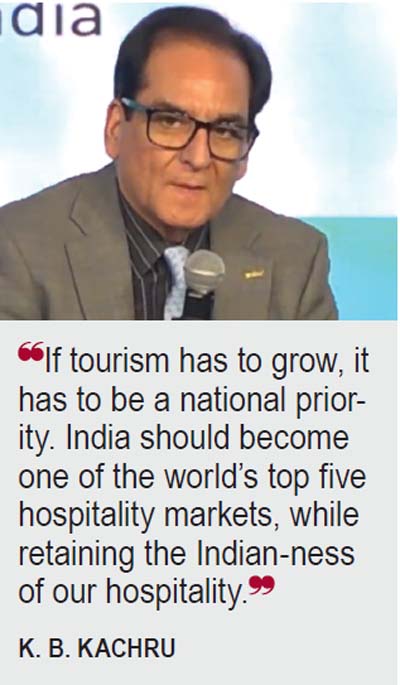
We don’t want doles. We want you to help us tweak your own policies so that industry can stand with you, deliver for you, deliver for the nation. And Mandeep, one last thing, if tourism has to grow, tourism has to be a national priority. It cannot happen otherwise.
Mandeep Lamba: The only trouble with all of this is that people in this house, we are preaching to the converted. But some wishful thinking here. Let’s assume that we move forward 10 years to 2036 and all three of us are back on stage. What do you think success will look like 10 years from now for our sector?
Jyotsana Suri: Who should answer? Who should go first? Should I go first? Please. Thank you so much. 10 years from now, I hope to see less gap between branded and non -branded, that’s number one.
I also hope to see more skilled people in the workforce and I hope to see infrastructure which is that last mile connectivity that we are talking about is in place. That’s what I think is the wishful thinking that we have and I also want people to come to India and not only the domestic movement but internationally. I want them to come to us. And I can see it like that, not because of the destination, but because how we make our guests feel.
Mandeep Lamba: Fabulous. Mr. Kachru.
K B Kachru: You know, I’ll go back to one key point. We have to be very clear about our vision of success. I personally would like to see India as one of the top five hospitality markets in the world. And one advice to ourselves is, Let’s not lose Indian -ness. India is very different. Let’s not… somebody said it… very well yesterday, let’s not move towards west for everything. India, India’s hospitality is the best. I would like to retain it. That’s my wish.