
Over 50 years of Tourism Advocacy
Building India's Travel Businesses
Emerging Challenges in Guiding Future Tourism Growth

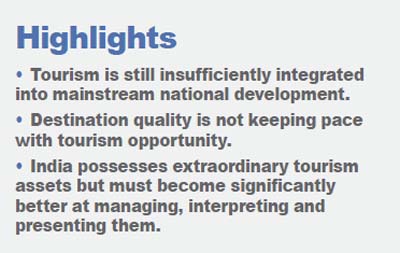 1. We are still thinking in silos.
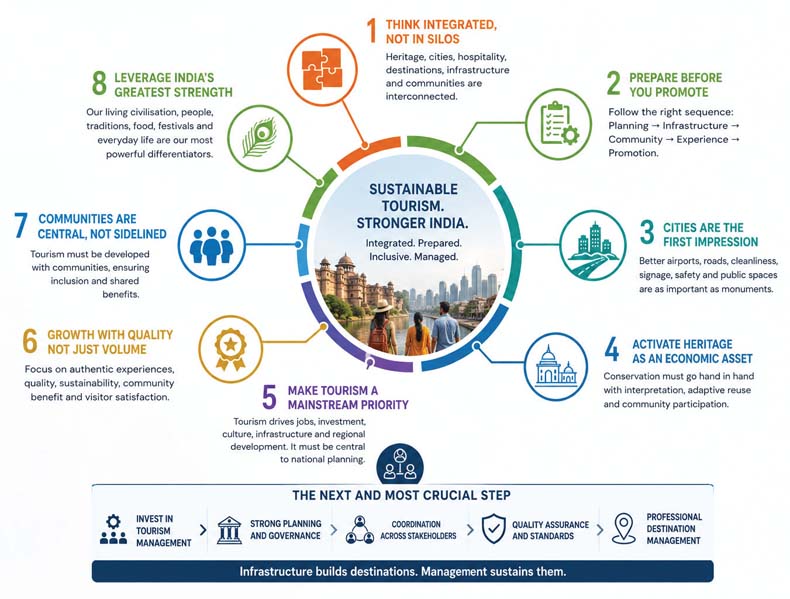
This was probably the strongest concern running through almost every session. Heritage was discussed separately from cities. Cities from hospitality. Hospitality from destination development. Destinations from communities. Yet every speaker, in one way or another, ended up saying the same thing: Tourism works only when all these elements work together. That fragmentation is perhaps India’s biggest structural challenge.
2. We still promote destinations before preparing them.
This emerged repeatedly during the discussions on cities, heritage and lesser-known destinations. There was an implicit warning: “Do not market what is not yet ready.” Promotion without planning risks disappointing visitors and damaging destinations. The sequence suggested by the discussions was almost always: Planning → Infrastructure → Community → Experience → Promotion. Not the reverse.
3. Cities remain India’s weakest link.
I think this came through more strongly than any of us anticipated. Almost everyone accepted that visitors remember airports, roads, pavements, cleanliness, signage, traffic, safety and public spaces as much as they remember monuments. In other words, India’s destinations are often better than the cities that serve them. That is a significant red flag.
4. Heritage is still treated more as an archaeological responsibility than an economic asset.
This was a recurring concern. Nobody argued against conservation. But several participants argued that conservation alone is insufficient. Heritage needs interpretation. Adaptive reuse. Community participation. Economic relevance. Otherwise, its tourism potential remains under-realised.
5. Tourism has not yet become part of mainstream development thinking.
This is perhaps the biggest philosophical conclusion. Many discussions implied that tourism is still regarded as a departmental responsibility. Whereas participants repeatedly described it as influencing employment, investment, cities, culture, hospitality, infrastructure, regional development. The implication was clear. India has not yet fully integrated tourism into its broader development strategy.
6. Growth without quality could become a future risk.
This emerged particularly from the experiential tourism and destination discussions. Nobody opposed growth. But many speakers questioned whether growth alone represents success. Quality. Authenticity. Community benefit. Visitor experience. These repeatedly emerged as equally important.
7. Community participation remains uneven.
Almost every discussion acknowledged communities. Far fewer examples suggested communities were consistently central to destination development. There was an implicit concern that tourism sometimes happens to communities rather than with them.
8. India risks under-utilising its greatest competitive advantage.
This is surprising. The conclave seemed remarkably confident that India’s strongest tourism asset is not a monument. Nor a beach. Nor wildlife. It is its living civilisation. Its people. Its traditions. Its food. Its festivals. Its everyday life. The implicit warning was that India sometimes markets places better than experiences.
One thing more striking perhaps. There was one red flag that nobody stated directly, but which emerged when all six sessions are read together. It is this. India is investing rapidly in tourism infrastructure. We must now invest equally rapidly in tourism management. The discussions repeatedly spoke about airports, hotels, destinations and cities. But beneath all those conversations lay another issue. Who manages these better? Who plans them? Who coordinates them? Who ensures quality? That is the next challenge.