
Over 50 years of Tourism Advocacy
Building India's Travel Businesses
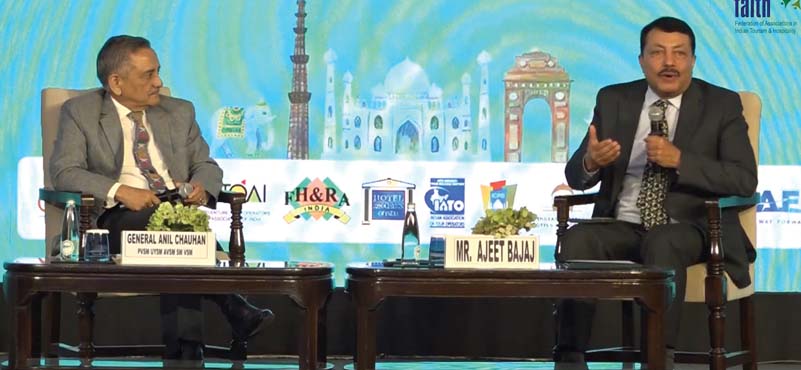
Border Tourism: Securing Frontiers, Creating Futures Gen Anil Chauhan

Ajeet Bajaj: Good evening, ladies and gentlemen. It is a huge honour, on behalf of the tourism, travel and hospitality fraternity of the country, to accord a warm welcome to General Anil Chauhan, former Chief of Defence Staff and a national hero.
At FAITH earlier this year, we signed an MoU with the Army Welfare Placement Organization to enable our veterans to join the tourism sector. Sir, to set the ball rolling, would you like to begin by sharing a travel experience with us?
General Anil Chauhan: Two days back, I was asked on a podcast what I would have been if I had not become an Army officer. I said I would have been a tour operator. I like visiting places and meeting people, and these two things are inbuilt in the Armed Forces.
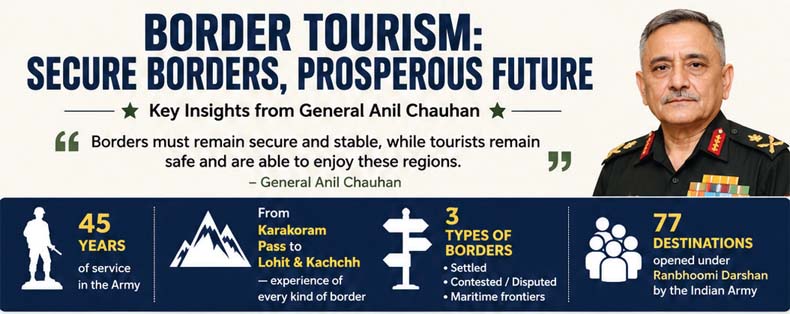
When you join the Army, you see exotic and unique places and meet border communities whom you would not ordinarily encounter. I was fortunate to serve for 45 years in uniform, and my journey took me along all our borders—from the Karakoram Pass to Lohit and Kachchh.
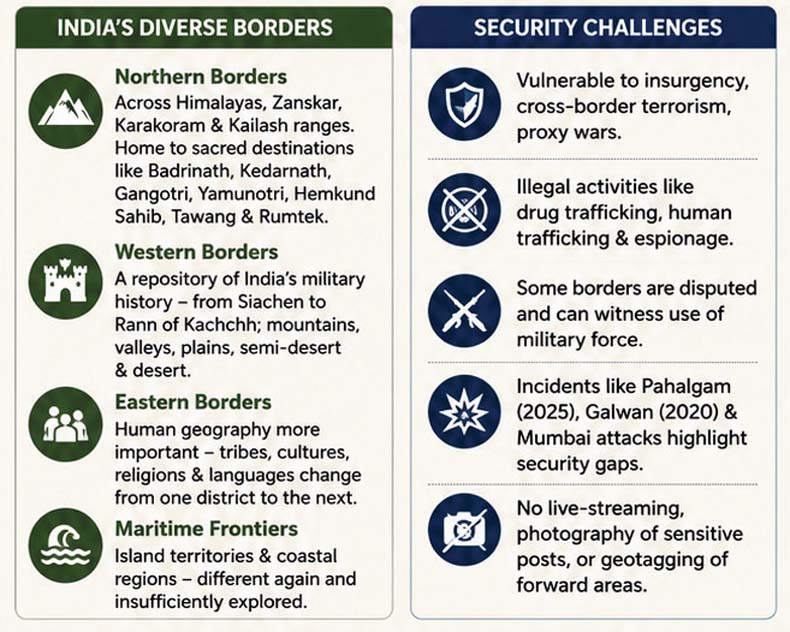
Every border is unique. The northern borders run across several mountain ranges—not only the Himalayas, but also the Zanskar, Karakoram and Kailash ranges. They embody divinity. Our great religious places—Badrinath, Kedarnath, Gangotri, Yamunotri and Hemkund Sahib, as well as Tawang and Rumtek monasteries—are located in this region.
The western borders are a repository of India’s military history. From Siachen to the Rann of Kachchh, they encompass high-altitude terrain, mountains, valleys, the plains of Punjab, semi-desert and desert. Many invasions came through this region, and much of the defence of the country was mounted there.
Along the eastern borders, human geography is often more important than physical geography. Tribes, cultures, religions and languages can change from one district to the next. Our maritime frontiers, comprising island territories and coastal regions, are different again and remain insufficiently explored.
Some of our borders are settled; others are contested or disputed. We have the Line of Control, the Line of Actual Control and maritime frontiers. Their geopolitical settings are different, as are their physical and human geographies. India therefore has experience of every kind of border.
Ajeet Bajaj: We have been working with the Indian Armed Forces to unleash the tourism potential of some of our border areas. How can we take this to the next level in a sustainable and responsible manner?
General Anil Chauhan: Borders lie at the extreme end of state sovereignty. They can be vulnerable to insurgency, cross-border terrorism, proxy wars and illegal activities such as drug trafficking, human trafficking and espionage. Some borders are disputed and can occasionally witness the use of military force. We have seen Pahalgam in 2025 and Galwan in 2020. Even the Mumbai terror attacks exposed gaps in coastal security.
At the same time, there is a need to develop tourism. Three elements must work together: tourists, the hospitality industry and local authorities.
Citizens must understand our security concerns. There can be no live-streaming or photography of sensitive posts, or geotagging of forward areas. The hospitality industry must educate tour operators and work with trusted guides, taxi operators and homestays. Local authorities—including the civil administration and Armed Forces—should promote tourism within a framework of regulation and control.
Ajeet Bajaj: Do we need a national strategy to open our border areas to tourism?
General Anil Chauhan: You are asking an Army officer about strategy—a word that has its origins in warfare. Its Hindi translation, rann neeti, conveys the meaning even better. So you are asking about a border tourism rann neeti.
The desired end state should be clear: borders must remain secure and stable, while tourists remain safe and are able to enjoy these regions.
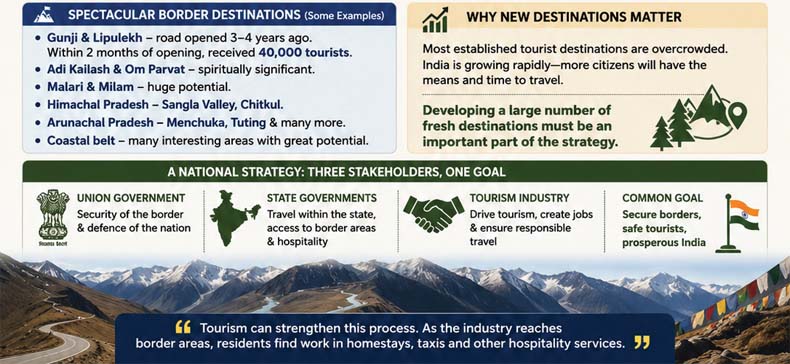
Three stakeholders are involved. The security of the border and defence of the nation are responsibilities of the Union government. Travel within a state, access to border areas and hospitality involve state governments. The third stakeholder is the tourism industry. All three must work together to develop a strategy for border tourism.
Ajeet Bajaj: If you were to identify the most spectacular border destinations in the country, which ones would you choose?
General Anil Chauhan: We have not yet opened all our borders to tourism. In many parts of the middle sector and Arunachal Pradesh, roads towards the forward areas are still being constructed.
 The road to Gunji and Lipulekh opened only three or four years ago. Earlier, the principal visitors were pilgrims going to Mount Kailash and Mansarovar Lake. Three days after my retirement, I went there to see Adi Kailash and Om Parvat. Within two months of the area opening, it had already received 40,000 tourists.
Malari and Milam are other areas with huge potential. In Himachal Pradesh, Sangla Valley and Chitkul are remarkable. In Arunachal Pradesh, Menchuka can be reached, though the border lies further ahead; Tuting and several other regions also offer great possibilities. There are many interesting areas along the coastal belt as well.
Most established tourist destinations are overcrowded. India is growing rapidly, more citizens will have the means and time to travel, and existing destinations will become even more congested unless we create new ones. Developing a large number of fresh destinations must therefore be an important part of the strategy.
Ajeet Bajaj: Bollywood has been a force multiplier in opening places such as Ladakh to tourism. Could films on our military history, such as the battle of Rezang La and Major Shaitan Singh, help promote border areas?
General Anil Chauhan: The Indian Army has already opened 77 destinations under Ranbhoomi Darshan. Famous battle sites—from Longewala and Kutch to Siachen Base Camp and other forward areas—are now open to the public, with tour guides available at these locations.
Bollywood films have certainly popularised places where wars were fought and made such destinations better known. But today, people can also visit many of the actual sites and experience that history for themselves.
Ajeet Bajaj: The website is bharatranbhumidarshan.org, and I would request our colleagues in the tourism and travel trade to promote these areas.
Our border villages are now described as the country’s first villages. Migration from them has been a concern, and retaining our first citizens in these first villages is a national priority. What economic activity can help achieve that?
General Anil Chauhan: Border villages have historically seen less development and fewer opportunities, which has encouraged migration. But as border infrastructure improves and roads move towards the frontier, reverse migration has begun in some parts of Arunachal Pradesh. People want to return to their villages.
 Tourism can strengthen this process. As the industry reaches border areas and promotes border tourism, residents find work in homestays, taxis and other hospitality services.
There is, however, a small conflict between your industry and ours. Young people in border villages have traditionally wanted to serve in the Armed Forces, particularly in Special Forces or scout battalions. Now, many prefer to stay home and operate a homestay or taxi.
We need a via media. When they are young, they should join the Forces and serve the nation. They make excellent soldiers because they are defending their own region and motherland. Once they retire, the hospitality industry can employ them through initiatives such as the ex-servicemen placement programme you mentioned. That would be a win-win situation for the Armed Forces, the tourism industry and border communities.
Ajeet Bajaj: Two years ago, we held a national tourism convention in Tawang and took many foreign visitors to Bum La. The idea was to say proudly that these areas are an integral part of our country. Should more border areas be opened to foreign tourists?
General Anil Chauhan: One of the Armed Forces’ responsibilities during peacetime is to maintain the legitimacy of our claims. Since many borders are disputed, we patrol these areas regularly and maintain a record of our presence. Mountaineering expeditions to peaks near the border and tourism in territories we claim also help reinforce that legitimacy.
We should promote such activities while respecting the security requirements laid down by local formations and Army units. Otherwise, I see no harm in opening most of these areas. They are our territory—why should they not be accessible to others?
Ajeet Bajaj: Would you share an instance of humour in uniform?
General Anil Chauhan: I belong to a Gorkha regiment. Many of the men have similar names—Ram Bahadur, Dhan Bahadur or Man Bahadur—so we often call them by their numbers. It is a tradition that makes identification easier.
When I joined my battalion, our adjutant was Captain Chauhan. The men were attending a cadre course for their first promotion and were asked to write the name of the adjutant. Some answered in Hindi and others in English, but one man wrote simply “54” in Arabic numerals.
I was puzzled. Later that evening, I realised that he meant “Chauhan.” Since the soldiers were known by their numbers, he assumed officers were too.
Ajeet Bajaj: As the former Chief of Defence Staff, what message would you like to leave with your fellow citizens?
General Anil Chauhan: We are at an important turning point in history. We have a vision of becoming a developed nation by 2047, and we can fulfil it only if all of us work together towards that goal.
Economic capability and military strength are intrinsic to a Viksit Bharat. As citizens, we should do nothing that harms either the economic interests or the security of the country. That is the message I would like to give.
Ajeet Bajaj: With your permission, may we take one or two questions from the floor, related specifically to border tourism?
Ravi Gosain: I head the association of inbound tour operators. Taking foreigners to our borders will not only help local economies but also give the world a different perspective on India. We should also remember that many NRIs hold foreign passports and would be very interested in visiting these regions. What are the challenges, from the Army’s point of view, in taking foreign visitors to our border areas?
General Anil Chauhan: The Army would be willing to open more areas not only to Indian citizens but also to foreign visitors, particularly because their presence can reinforce the legitimacy of our claims.
This need not be limited to visits to particular locations. It can include adventure tourism and mountaineering expeditions to peaks along the border. It can also include ecological study. If researchers or visitors want to map the presence of snow leopards, spectacled monkeys, butterflies or other species, we are open to that as well.
Security considerations will, of course, remain important, particularly in sensitive or disputed areas. But these activities can be worked out in consultation with local Army formations and the civil administration. The tourism industry can engage with them and develop visits that are both responsible and secure. We are open to these possibilities.