
Over 50 years of Tourism Advocacy
Building India's Travel Businesses
Tourism: Unleash India’s Jobs Engine

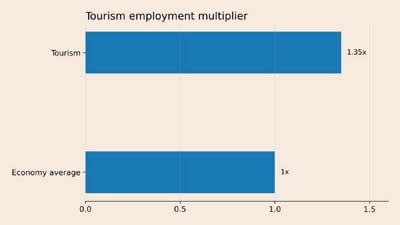
Elephants are not raised on peanuts. India must create 10 million jobs annually to employ its youth and preserve social harmony. With 48 million employed and every rupee invested generating 35% jobs than the economy’s average, tourism offers a transformational jobs engine for a nation hungry for growth. Yet, with a mere 0.05% of the Union Budget allocated to tourism, India underserves a golden opportunity.
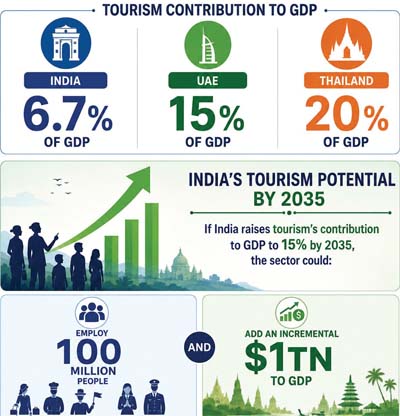
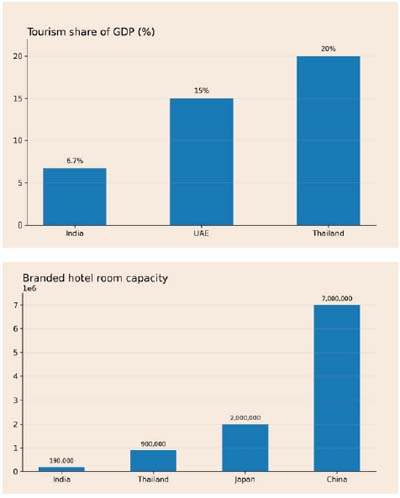
Tourism contributes 6.7% to India’s GDP. It is 15% in the UAE, and 20% in Thailand. Were India to raise Tourism’s contribution to 15% by 2035, the sector could employ 100 million people and add an incremental $1tn to GDP – roughly the output of a mid-size G20 economy.
The Paradox
 India, with 44 UNESCO World Heritage Sites – and blessed with mountains, temples, palaces, and beaches should be a tourism superpower. Instead, it is held back by policy drift, patchy execution, and a neglect of the basics. Capacity is central to the problem. The estimated daily lodging demand is five million beds, yet India has barely 190,000 branded hotel rooms. Vietnam has more than 200,000; the UAE, 220,000; Thailand, 900,000; Japan, two million; and China, seven million.
India’s weakness is most visible in international tourism. In 2024, it welcomed 10 million foreign visitors, while 30 million Indians travelled abroad, producing a net forex outflow. Peer comparisons are sobering. Vietnam attracted 18 million visitors, the UAE 19 million, and Thailand 36 million.
What Viksit Bharat Requires
Three reforms would unlock much of this potential.
First, move Tourism to the Concurrent List to end the Centre-State coordination quagmire.
Second, scale supply rapidly.
Third, fix the last-mile experience.
A Supply Surge
 India should aim to add one million branded hotel rooms by 2035. Fragmented incentives can be knitted into a national framework. Ten-year CGST reimbursements, modelled on the Northeast UNNATI scheme, will spur investment in Jammu and Kashmir, Uttar Pradesh, Madhya Pradesh and Bihar. Existing state incentives – Maharashtra and Assam’s 15-year SGST refunds and Odisha’s 30% capital subsidy – could be standardised. Public land could be leased on 60-year DBFOT terms with modest upfront payments.
Simultaneously, homestays should be scaled to 500,000 rooms through online Aadhaar-based registration and digitally self-certified tiered quality standards. Modest grants ₹1/₹2 lakh per rural/urban room, tied to basic hygiene and safety norms, and paired with partnerships with branded operators, could formalise supply without stifling local enterprise.
Financing need not be a constraint. A $10bn India Tourism Fund, structured as a sovereign-private InvIT, could anchor the expansion. Select assets of ITDC and state tourism corporations could seed the fund, complemented by viability-gap financing from NaBFID and multilaterals such as the IFC, ADB and JICA. Saudi Arabia’s dedicated Tourism Development Fund can be benchmarked for charter and outcomes.
Fixing The Last Mile
Tourism succeeds or fails on last-mile quality: clean toilets, sufficient parking, safe streets for women, and efficient queues. India underperforms on all four. A nationwide “Mission Cleanest Cities” could grade districts on civility, safety, and cleanliness (Sabhyata, Suraksha, Safai), with a slice of GST transfers linked to measurable outcomes.
Decommissioned Agniveers could be deployed as tourist police. Pilgrimage queues should be digitised, as at Mumbai’s Siddhivinayak temple. Functional infrastructure – electric shuttles, shaded walkways, and multilingual signage – should be the norm, not an exception.
Building Human Capital
 Tourism is as much a social compact as an economic activity. Respect for heritage, cleanliness and women’s safety needs to be embedded in school curricula. Organised school tours to national sites – from Sabarmati to Sriharikota and the Statue of Unity – would foster civic consciousness, scientific temper, and national pride.
Mawlynnong in Meghalaya – also known as Asia’s cleanest village and a zero-crime destination – illustrates how community ownership of heritage can translate into superior visitor experiences.
Skills, too, must catch up. Vocational training should be rapidly scaled through hotel-school hybrids and stackable online certification overseen by the National Institute of Hospitality.
Political Will
The Union Budget last year promised infrastructure status for Tourism, the upgrading of 50 destinations, and the ‘Heal in India’ initiative. None has yet been meaningfully implemented.
What is needed is sustained attention from the top. A Prime Minister-chaired Standing Committee on Tourism could cut through inter-ministerial silos and enforce delivery.
For a nation that must generate millions of jobs each year, failing to fully mobilise tourism is not a policy oversight. It is a strategic error. Tourism must be funded adequately, aligned coherently, and executed relentlessly to unleash its full potential for nation-building.
ABOUT THE AUTHOR
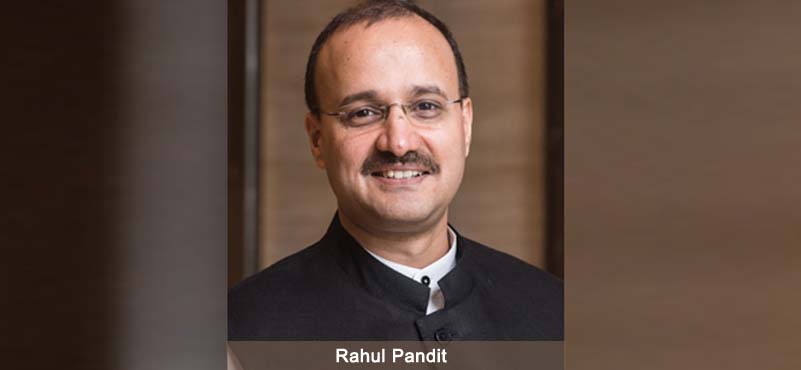
Rahul Pandit, Member-CII National Committee on Tourism, Member-CII National Committee on Logistics, Member-UP Chief Minister’s Economic Advisory Group, Independent Director on the Board-ixigo, MD & CEO Advent Hotels International.