
Over 50 years of Tourism Advocacy
Building India's Travel Businesses
Tourism Needs Bigger Attention from both Government and Industry

Realise the Economic Power of Tourism; spend more and earn more from it. It could be the game changer for the economy, says Ashish Dhawan, Founder, Ashoka University in his keynote address at the recent Oberoi Hotels’ Global Hospitality Conclave in New Delhi.
“When I started Chris Capital, which is a private equity firm, I was originally in Bombay and Delhi. Our office was actually here, the Oberoi Hotel, 2003 onwards, for over a decade actually. So very thankful that I could come to work here every day, go to the gym here. It’s like home.
 And my own journey in terms of transitioning from the corporate world to the social sector, doing philanthropic work, actually happened in this hotel. Before I decided to make the transition, I didn’t just want to leave without anything in plan. So, I had this idea that in my 40s, I must leave my corporate career and do something that’s more publicly spirited. And as I sort of approached 40, I started thinking about it. Sanjeev Bhikchandani, who started Naukri.com, encouraged me. So, he and I had lunch, actually, in this hotel. And we conceived the idea of Ashoka University. We had several meetings then. Every Saturday we would meet once a month in the conference room in 101. That’s where Ashoka University was born in a sense. Our group would meet there and then eventually we had the courage to go ahead.
But after seeing all these nice things, I do want to, and listening to the remarkable man that Rai Bahadur was, I do want to say that I think the Oberoi group is not good, that your industry is not good, that we have really failed our country. I’m saying this to be provocative and well -meaning. I actually have started a number of foundations after the ones in education, 10 or 15 in the last six, seven years. One of them is called the Atithi Foundation that works on tourism.
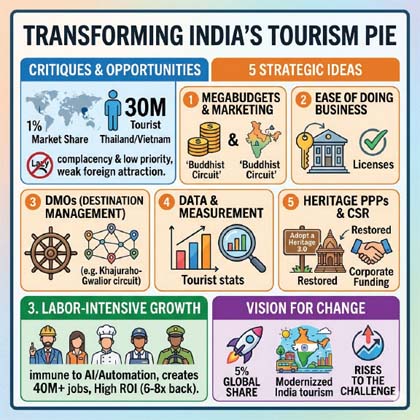
So, I’m very new to tourism. It was only started a year ago. But in the process, I’ve met a lot of people at state level, government, private sector, etc. I think it’s shameful that at this stage we get 1% of the world’s foreign tourists. It’s a shame. 10 million foreign tourists come to India, 30 million go to Thailand. China used to be more, now that China is blacklisted, 30 million still go to China.
Vietnam, which is a puny little country, 21 million foreign tourists. So, I know that it’s easy. It’s like with our other businesses, manufacturing firms, consumer goods firms, get lazy. Because we have a large domestic market and that doesn’t give them the ambition to be global or to attract global, or to export, et cetera, et cetera. I somehow feel that our whole tourism industry has also been lulled into complacency because we have a large domestic market.
 It’s a shame that Goa attracts half a million tourists a year. It’s actually much below where it was pre -pandemic. And that Indians don’t want to go to Goa and want to go to Phuket instead, which, by the way, attracts 10 million foreign tourists a year. I’ve worked with the government on many other things. I must say, this is not a priority. Whatever you may say, it’s not a priority.
It’s not reflected in the budget. Central government has a budget of 2,500 crore, nothing. It’s ridiculous. I don’t understand, you know, it’s the industry, and I’ve interacted with the CII and FICCIs, people who represent the industry, and some of them CEOs of companies.
But my view is they make little asks instead of looking at how to grow the pie. How do we make the pie larger?
So, what I’m going to present for you is just four or five ideas, and I hope that you will be my partner in pitching this to government so that we can actually grow the pie. And not grow the pie for domestic tourists, that’ll happen naturally, but really have a vision and grow the pie to attract foreign tourists. Every foreign tourist spends much more and there’s huge spillover benefits going forward.
This is, by the way, the most labor -intensive industry in an age of AI, where everybody’s worried about knowledge workers and what will happen to IT experts, which is really a risk. I was in China for a week or so, and I was there even in November last year. By the way, the robots are coming. So even in sectors like manufacturing, I’ve been to a lot of factories in China, completely automated. And the Chinese are now working on an agricultural robot, construction robot. We have two -star, three -star hotels in China where the receptionist is a robot.
Obviously, delivery, we know robots do. But even then, they’re working on a cleaning robot. They haven’t gotten the sheets quite right, but they’ll get there because the hand is dexterity. They’re getting very close. So I still think that it’s going to take a long time in the service industries for robots to come. It’s going to come to manufacturing first, and it’s going to come to knowledge.
 So, this is the one industry that can really create jobs. There are already 40 million jobs. And I think the next 40 million jobs are going to come. But if we don’t think of growing the pie, if we don’t think of making a foreign tourist base, then…
Let me give you three, four ideas. Firstly, we spend nothing on marketing. Can anybody guess what our budget was for marketing? Incredible India was this campaign that we ran for government. I’m not saying that marketing is going to fix the tourist experience and the structure, all of that. But last year’s marketing budget by Govt of India, which is, I think it’s just ridiculous. 3 crores.
Thailand spends $200 billion. How can you, where is the awareness going to be created? And the only thing, therefore, that happens on social media is negative stuff. India is unsafe. I really think we have to work to convince. I know there was some issue with this marketing budget earlier, pre -COVID.
And that’s created something in the minds of leaders. But as an industry, to make this pitch, the budgets have to go up. This 3 crore is ridiculous. The 2 ,500 crore central government budget is ridiculous. And it’s spread like peanut butter. It’s spread so thin it has no impact at all.
State governments spend nothing. So, first point is, we have to spend much more. Marketing, infrastructure, we want to really improve. By the way, the ROI on tourism is actually extremely high. If you look at economic studies, job creation is very high. But for every rupee spent by government infrastructure, payback is 6 -8 % of the deposit. GST, direct taxes, whatever taxes, you know, et cetera. So, it’s a no -brainer. You’re getting six to eight times your money back, unless nobody shows up, unless these are, ghost hotels. I mean, unless nobody shows up to generate the revenue, which I think is not the case. In India, we’ve just underspent. So, point number one is we underspend.
Point number two is we need to radically improve the ease of doing businesses.
We’ve done a lot of detailed work, and you all know more than me, because we set up hotels, have been to hotels, and all the different licenses and standards, and the time delays. But we shared a lot of what we have found with NITI, but also with the CABSEC, as you know the CABSEC has this task force now working on deregulation at the state level. The good news is that in phase one, the hotel industry wasn’t able to do it, but in phase two it has been. It is also NITI pushing. But I think now is the right time to push hard because they accepted the fact that the ease of doing business needs to improve. So, this is the moment to strike. Make the bold asks and to ensure that not only is it easy to set up a hotel, or operate a hotel, or restaurant, or cafe, or homestay, or whatever. There are so many inconsistencies in homestay policies. I think we need to fix that. And not just the ease of doing business, the cost of doing business. Hotels are a very small footprint in urban India. If the land cost is high, somebody should be making a case that we need to lower the cost of doing business.
A third is what I would say is the idea of a destination management organization. Tourism has a problem. Our ministry has very limited power. It’s a coordinating body at best. The same at state level. It doesn’t have the authority that really help the people. We want to go from 10 million to 20 million people. Infrastructure, work with urban local bodies, transportation, civil aviation. There’s lots of departments, ministries at play.
The idea of a destination management organization is that it pulls all this together, so there is a body to help coordinate. Many of you will know this, but when the Statue of Unity was built, in Gujarat, they actually put, they passed an act to empower the CEO of that authority to then develop the region. That person was tasked with creating a plan, a road map, looking at the infrastructure, making the asks, going out and soliciting investment to come in, ensuring that the tourist experience was good. That CEO happens to be an IAS officer. But that doesn’t need to be the model.
I think a DMO model could be put in place where there’s a private sector CEO for the destination management. And the best DMO would be for a circuit. So northern Madhya Pradesh, you all set up a beautiful hotel in Khajuraho. I think there is that circuit from Khajuraho to Orchha to Chanderi to Gwalior. There’s a circuit, probably five days or something. And there needs to be a DMO to manage that.
And around the world, this is not an alien concept. So, I think the industry should be pushing hard that we need DMOs at least across the top circuits. And in some cases, we need to be even bolder and say, let’s give the DMO completely to the private sector. Let’s work on the economic part. Hampi had 20,000 foreign tourists a year, for what? Let’s program it. A similar asset, I mean, you think about it, you go to one and say, it’s world class, and you go to the other one and say, it’s nothing. It’s the equivalent. It’s a 50x better. Radical idea, put out a PPP and maybe give it to the Jindal group, as an example. So it’s not just depending on CSR. So, I think there are ways to do it, but the most important is to set up this DMO structure.
The industry needs to push back. Convince the ministry, convince NITI, they now believe in it. We are working with a couple of states to start DMOs. But I think that’s the only way we’ll improve the tourist experience. Otherwise, we’ll always be stuck with a coordination problem. And nobody will have the vision for it.
You know when we went and met the Punjab Chief Minister, Amritsar gets huge footfall because of the Golden Temple. They don’t monetize it because hardly anybody stays overnight. And if they stay a night, it’s the same experience. There are 8 sites around Amritsar that could be developed to ensure that people stay 2 or 3 nights as opposed to just zero nights. So, I think that’s the third idea is we need DMOs – destination management organizations, ideally backed by an app so that there’s some authority.
I realize in some urban areas, it’s hard to give a lot of authority because all the other bodies have the authority. There, we need a light touch DMO which is responsible for the tourism plan, the marketing, and the investment in the nation. But in areas that are more Greenfield, you could have a heavy touch.
Finally, I would say that we have a data problem as well. We don’t measure, we are digital everywhere, you know, we go to the airport, etc. There needs to be a sort of digital tourism stat, data, and make it even easier with all kinds of experiences and things you can measure. The measurement today is extremely poor, other than the foreign tourists landing in. I mean, the self-reported data coming from the industry is not very good. The industry itself doesn’t know. But there’s a data problem.
We use GST data to try to estimate tourism revenue and self -incentive. But they just didn’t have the data to apply it. So, while they didn’t put in much money, but in order to create a plan, you need to have some number, some baseline to start.
And then, of course, I think there are small things like this PPP model. That’s not with the tourism ministry. It’s with the culture ministry. It’s with the ‘adopt a heritage’.
They have adopt a heritage. We are now working, I think there is a 3.0 because there are still lots of issues in terms of ironing it out. And here, CSR is allowed. But if we can get this ironed out2, I would really like the 104 corporates to take up 500 sites across India, really improve the experience, the cleanliness, the amenities, the sound and light show, the cafe and restaurant experience there, all of that stuff. There’s even a radical idea now to open up conservation to an empaneled set of folks. Right now, ASI has pretty much a monopoly on the restoration of that. Why can’t that be opened up? Again, empanel people who you think are worthy of doing it.
And then let CSR fund it alongside government. Why prevent someone if they’re interested in restoring this site? Aga Khan foundation did a great job, but that’s like a one -off. They did it in three, four places, but it’s a one -off. We need to really open this up so that corporates can get much more engaged with really transforming, because there’s no other place in the world that has such a wonderful set of monuments, not just in Delhi, but all over the country. China doesn’t have it because they’re destroying a lot of their heritage.
I’ll just recap the sort of five things I said. First is bigger budgets. Shame that we have a 3crore marketing budget. Shame that the overall budget is 25crore. It’s a shame that states like Rajasthan have a 1 ,000 crore budget. We’ll just need to change the budget. We need to lobby for more.
The Buddhist circuit alone, it will be 10 ,000 crore. Tinkering around is not going to make any difference. This is the Mecca of Buddhism. It’s the equivalent of Mecca for Buddhism. It’s the source where every Buddhist should come to. In fact, the marketing campaign should be exactly that. Once in your lifetime, you have to come to Bodh Gaya. And we need to think of the ROI of that 10 ,000 crore. There are 500 million Buddhists, many of them fairly high income in East Asia. A complete missed opportunity. We’re tinkering around with these programs right now. And I can tell you there are at least five circuits in India that need a massive dose of capital. And then the private sector will come. And the private sector will invest 10x more capital eventually, over a decade. If private sector will build everything else around the business.
The second thing is ease of doing business. It just has to become a benchmark against the best in the economy. And I really feel that if you all are willing to talk to us, we will work with you. I will lobby hard to get the FSI and the opportunity for this sector, because the footprint is so low. We need to make it. This sector, as I told you, it’s the most labour intensive.
The third one is the DMO. The fourth one is this private sector. But I really think that the Oberoi group and the industry really needs to rise. I think 10 million is a shame. It’s a shame. You need to get in your head that it’s a shame. Every one of you should be asking how you can play some role in changing that, working to make India a destination. Not a place that has 1% of market share, but a place that eventually has 5%. That’s my vision for you. Thank you very much.