
Over 50 years of Tourism Advocacy
Building India's Travel Businesses
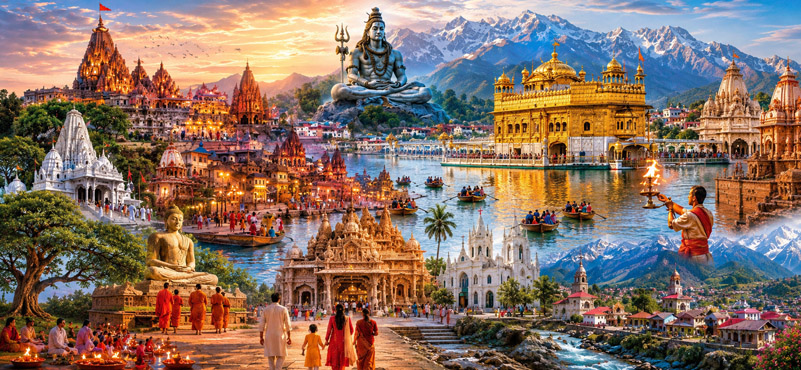
India’s Next Big Growth Story: The Rise of the Faith Economy

For decades, India’s growth story revolved around sectors such as information technology, automobiles, pharmaceuticals and manufacturing. More recently, entirely new engines of economic activity have emerged — renewable energy, electric vehicles, defence manufacturing, data centres and digital infrastructure. Yet, quietly and often underestimated, another giant economic force has been taking shape across the country. It cuts across airlines, hotels, roads, food, retail, handicrafts, digital payments, events, urban infrastructure and tourism. It is deeply emotional, culturally rooted and remarkably resilient.
It is India’s growing faith economy.
At one level, the term itself sounds simplistic. Yet what is unfolding across India is far larger than traditional religious tourism. What we are witnessing is the rise of an integrated ecosystem around pilgrimage, spirituality, heritage and cultural identity. And unlike many modern sectors concentrated in metropolitan India, this one is transforming smaller towns and regional centres across the country.

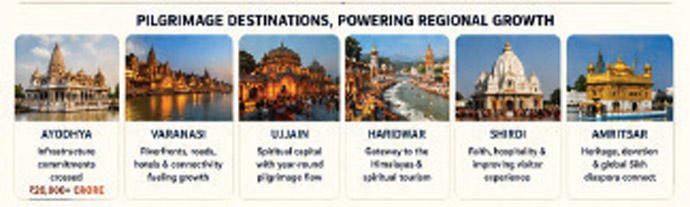
Places such as Ayodhya, Varanasi, Ujjain, Haridwar, Shirdi and Amritsar are no longer merely pilgrimage destinations. They are evolving into economic ecosystems in their own right.
The sheer scale is staggering. India records well over a billion religious and pilgrimage-linked visits annually if major festivals and repeat domestic journeys are included. The Ministry of Tourism has previously estimated religious tourism-linked movement at over 1.4 billion visits in a single year. Even conservatively measured, the broader faith economy — including transport, hospitality, food, retail, donations, local commerce and associated services — is now believed by several industry estimates to be worth anywhere between ₹10 lakh crore and ₹15 lakh crore annually, or roughly US$120–180 billion.

 That already places it among India’s largest economic activity streams.
To put this in perspective, India’s pharmaceutical industry is estimated at roughly US$65 billion, while the domestic aviation market remains significantly smaller in direct revenue terms. The faith economy, though still undercounted and largely informal in parts, is already operating at a scale comparable to some of India’s largest sectors.
What makes the Indian model unique is its diversity. Unlike Mecca, which revolves around a singular pilgrimage structure, or Vatican City, centred around one globally recognised religious institution, India possesses a distributed sacred geography. The country hosts Hindu pilgrimage circuits, Sikh shrines, Buddhist heritage destinations, Sufi centres, churches, yoga and meditation retreats, river pilgrimages and spiritual festivals — all existing simultaneously within one civilisational landscape.
That creates an economic opportunity unlike any other in the world.
 One of the biggest drivers of this growth is improving infrastructure. Roads, expressways, regional airports, railway modernisation and riverfront developments are fundamentally altering access to pilgrimage destinations. The transformation underway in Ayodhya perhaps best represents this shift. The development there is not merely about the construction of a temple. It includes airports, hotels, roads, lighting, riverfronts, urban redesign, public spaces, tourism infrastructure and connectivity.
By some estimates, infrastructure commitments linked directly and indirectly to Ayodhya have already crossed ₹20,000 crore. Land prices have multiplied sharply. Hotel groups, airlines, travel companies and investors are entering a city that until recently remained largely outside mainstream tourism economics.
This model is likely to spread across multiple destinations in the coming years.
Equally important is the emergence of branded hospitality in pilgrimage centres. Historically, religious towns depended largely on dharamshalas, guest houses and modest accommodation. That equation is changing rapidly. Rising incomes, changing expectations and increasing middle-class travel are creating demand for organised hospitality, clean accommodation, reliable food services and curated experiences.
Hotels are beginning to recognise that pilgrimage traffic can often be more stable than seasonal leisure tourism. Pilgrims travel throughout the year. Festivals create periodic surges. Elderly travellers require comfort and reliability. Families increasingly seek cleaner and safer environments. The result is that branded hotel chains, boutique heritage properties and wellness resorts are entering markets that were once considered outside the organised tourism sector.
This hospitality expansion also extends to the Indian diaspora.
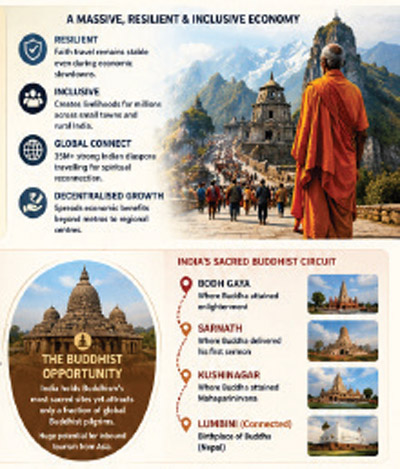
An increasingly affluent and emotionally connected overseas Indian community is returning to India not merely for family visits, but also for spiritual and heritage journeys. India’s diaspora now exceeds 35 million people globally. Even if a relatively small percentage undertakes regular spiritual travel to India, the economic implications are significant.
This is particularly visible in Sikh religious tourism centred around Golden Temple and other historic gurudwaras. The Sikh diaspora, spread across Canada, United Kingdom and United States, maintains a powerful emotional connection with Punjab and Sikh heritage. These visits often combine pilgrimage with family travel, shopping, heritage exploration and tourism, significantly increasing economic impact.
The same is increasingly true for the global Hindu diaspora. Destinations such as Ayodhya, Varanasi, Haridwar and Tirupati are beginning to attract overseas Indians seeking cultural continuity and spiritual reconnection. These travellers tend to spend more, stay longer and engage across multiple sectors including airlines, hotels, retail and local tourism services.
At the same time, India may still be underestimating one of its biggest spiritual tourism opportunities — Buddhism.
ABOUT THE AUTHOR
 Navin Berry, Editor, CS Conversations, over five decades has edited publications like CityScan, India Debates and Travel Trends Today. He is the founder of SATTE, India’s first inbound tourism mart, biggest in Asia.
Blogs at: https://www.csconversations.in/nb-blogs