
Over 50 years of Tourism Advocacy
Building India's Travel Businesses
The House That Holds a Democracy’s Memory

How the Prime Ministers Museum and Library became one of India’s most ambitious cultural institutions — and why it matters now more than ever.
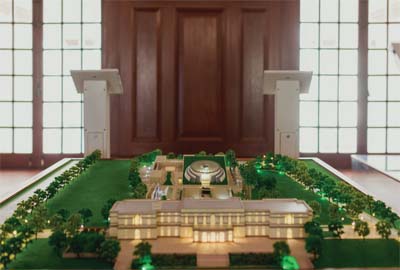
Nestled within a thirty-acre estate south of Rashtrapati Bhavan, at the heart of Lutyens’ New Delhi, stands an institution that defies easy categorisation. It is part museum, part national archive, part academic research centre, and part public observatory. It is, in short, what a serious democracy looks like when it chooses to examine itself. The Prime Ministers Museum and Library — known as PMML — has, in recent years, undergone a transformation so sweeping that calling it a renovation would be a profound understatement.
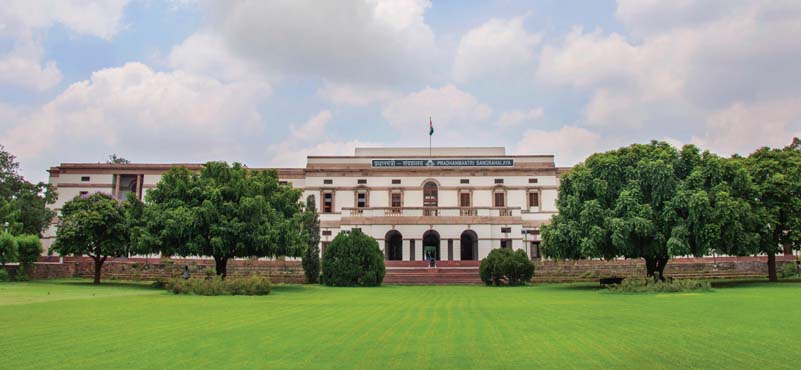
 The estate’s origins trace back to 1929–30, when British architect Robert Tor Russell designed Teen Murti House as the official residence of the Commander-in-Chief of India, part of Edwin Lutyens’ grand imperial capital project. The building’s very bones were meant to project authority and permanence. That they survived partition, independence, and nearly a century of political change is itself a form of testimony. After the departure of the last British Commander-in-Chief in 1948, the residence passed to Jawaharlal Nehru, India’s first Prime Minister, who would make it his home for sixteen years until his death in May 1964.
On Nehru’s 75th birth anniversary — November 14, 1964 — President Sarvapalli Radhakrishnan formally dedicated Teen Murti House to the nation, inaugurating the Nehru Memorial Museum. On 1 April 1966, the PMML (then NMML) Society was formally constituted as an autonomous institution, with the mandate to preserve and promote research on modern and contemporary Indian history. For decades, the institution served this purpose with quiet distinction, its archives attracting scholars from across India and the world.
A Vision Recast
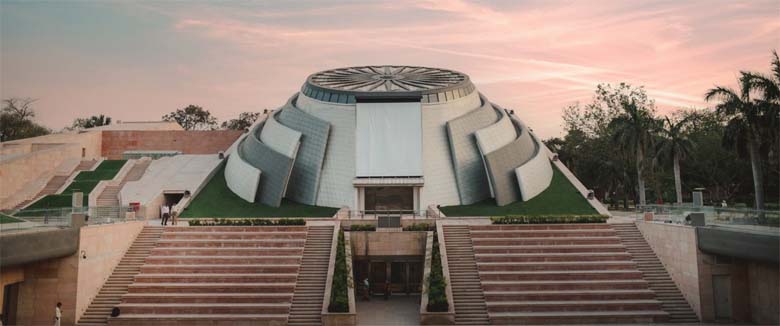
The decisive expansion of institutional mandate came with the inauguration of the Pradhan Mantri Sangrahalaya on 14 April 2022, Dr. B.R. Ambedkar Jayanti, by Prime Minister Narendra Modi. In a significant gesture of democratic inclusiveness, the new museum covering an exhibition area of approximately 15,600 square metres — was conceived to honour not one Prime Minister but all of them. The institution’s formal renaming to Prime Ministers Museum and Library in August 2023 completed this transformation in both spirit and identity.
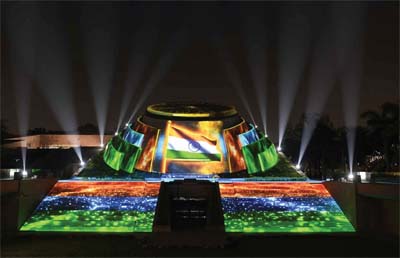
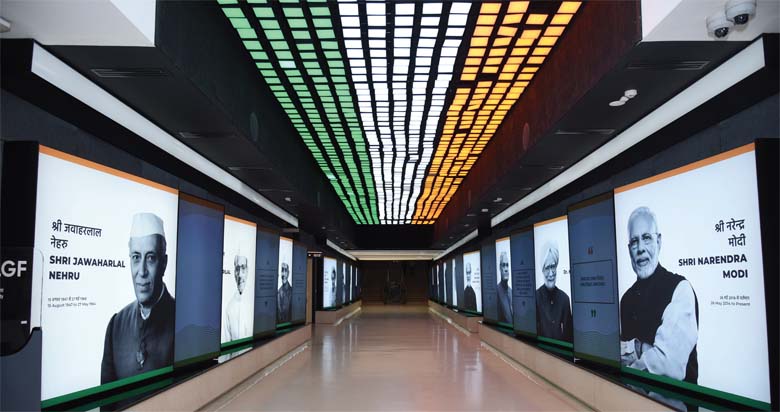
The museum is organised into two blocks. Block I, housed within the refurbished Teen Murti Bhavan itself, focuses on the founding years of the Republic. It includes exhibits on the making of the Constitution, a dedicated gallery on Nehru, the Toshakhana gallery displaying historically significant gifts and artefacts, and — perhaps most poignantly — Nehru’s preserved living quarters: his study, bedroom, and drawing room, maintained with a fidelity that collapses the distance between visitor and history. Block II of the Pradhanmantri Sangrahalaya in New Delhi—the museum’s new building—offers an immersive experience powered by a full arsenal of contemporary museum technology. It features large-scale projection mapping, detailed galleries on India’s Prime Ministers, VR pods, and an AI-powered HoloBox showcasing hyper-realistic 3D avatars of prominent national personalities, including Mahatma Gandhi, Dr. A.P.J. Abdul Kalam, Sardar Vallabhbhai Patel (now operational) and Atal Bihari Vajpayee (under development). The museum also employs AI-driven personalisation of visitor journeys and recreated decision rooms that place guests inside the most consequential moments of independent India’s governance, creating an engaging narrative of the nation’s political and administrative history.
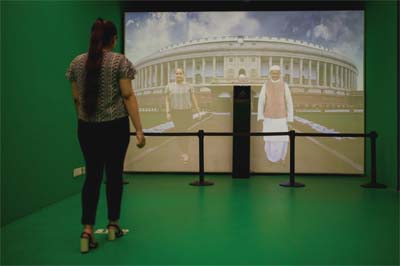 “The museum treats the office of Prime Minister as the subject of inquiry — and its occupants, across every era and political tradition, as custodians of a shared national story.”
The galleries are structured thematically around each Prime Minister’s tenure, covering early life, political journey, the making of a Prime Minister, significant works in office, and enduring legacy. The effect is cumulative and — for a visitor willing to linger — genuinely illuminating. One does not simply view exhibits; one traverses eight decades of democratic governance, from Nehru’s vision of a scientific and secular republic to the economic liberalisation of 1991, from the Bangladesh Liberation War to the digital revolution. The museum contains hours of curated immersive content. Daily footfall typically ranges between 1,500 and 2000 visitors; combined with the Nehru Planetarium, the PMML campus drew 6,08,765 visitors in 2024–25, rising to 6,40,419 in 2025–26.
Archives: A World-Class Repository
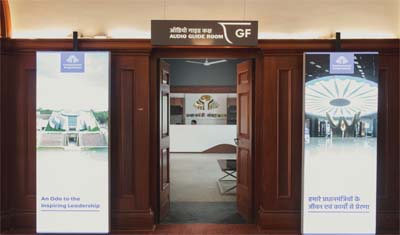 Beneath the gleaming surfaces of the new museum, a quieter but arguably more profound institution continues its work. The PMML Archives constitute one of the world’s largest collections of primary source material on modern and contemporary history, housing over 25 million documents drawn from more than 1,300 individual and institutional collections. The holdings span considerable breadth of India’s political and social landscape: the personal papers of Mahatma Gandhi, the correspondence of C. Rajagopalachari, the documents of Jayaprakash Narayan and the JP Movement of 1974, the private papers of Sarojini Naidu and Rajkumari Amrit Kaur, and the records of countless others who shaped independent India.
In a landmark development announced in November 2025, PMML launched a dedicated digital archives platform that allows registered scholars to request and view specific archival documents remotely, without the need to visit the premises. The initiative — described by Director Ashwani Lohani as reflecting the institution’s commitment to promoting high-quality research and strengthening the study of modern and contemporary India — represents a significant step toward global accessibility.
Scholarship, Fellowships, and the Centre for Contemporary Studies
The intellectual life of PMML extends well beyond its museum walls. The Centre for Contemporary Studies, established in 1990 anchors the institution’s academic mission. The CCS facilitates interdisciplinary seminars, research grants, academic partnerships with universities, and an annual conference series on modern Indian history. Its fellowship programme — offering positions at Junior Fellow, Fellow, and Senior Fellow levels, as well as the specialised Atal Bihari Vajpayee Fellowship on Prime Ministers of India and a Scholar-in-Residence programme — has supported some of India’s most distinguished historians and policy scholars.
The Nehru Planetarium and the Campus as Ecosystem
 Any account of the Prime Ministers’ Museum & Library (PMML) would be incomplete without mentioning the Nehru Planetarium, a premier centre for astronomy education and public engagement. Inaugurated on 6 February 1984, the Planetarium has spent four decades nurturing scientific curiosity across generations of Delhi’s schoolchildren through its immersive astronomy shows and educational programmes. A recent highlight is the newly renovated Aryabhata Gallery, formally opened on National Space Day (23 August 2025) by Group Captain Shubanshu Shukla—the second Indian in space and the first Indian to dock at the International Space Station. Named after India’s first satellite and the legendary mathematician-astronomer Aryabhata, the gallery showcases India’s scientific journey from ancient discoveries to modern ISRO-led space exploration. The Planetarium draws visitors who might not otherwise engage with the broader cultural and historical riches of the campus, creating a multidisciplinary environment where history, governance, and science share the same address.
Together, these constituents — the museum, the library, the archives, the CCS, and the Planetarium — form an ecosystem unlike anything else in India’s institutional landscape. The campus covers thirty acres in the heart of the capital, its grounds offering a rare space for contemplation amidst the city’s relentless energy.
An Institution for Its Moment
There is something timely about PMML’s evolution. In an era defined by diminishing attention spans, and a global conversation about who gets to tell a nation’s story, the museum’s inclusive curatorial philosophy — its insistence that all Prime Ministers, regardless of political tradition, deserve to be understood and remembered — is both a cultural statement and a civic act. The institution does not adjudicate between its subjects. It presents, contextualises, and invites the visitor to reflect.
The Teen Murti campus is not, and should not be, thought of as a monument to a concluded chapter. It is a living, growing, questioning space — one that holds the memory of a democracy in trust, and offers it back to the people that democracy belongs to. Come for the history. Stay for the ideas.
ABOUT THE AUTHOR
 Rahul Garud is a civil servant with experience in public finance, administration, policy coordination and institutional governance. He is presently serving as Financial Controller at the Prime Ministers Museum and Library, New Delhi. His areas of interest include public policy, fiscal management, governance reforms, India’s development journey, and the institutional foundations of Viksit Bharat @ 2047. He writes on issues relating to economy, governance, public administration and India’s future trajectory.