
Over 50 years of Tourism Advocacy
Building India's Travel Businesses
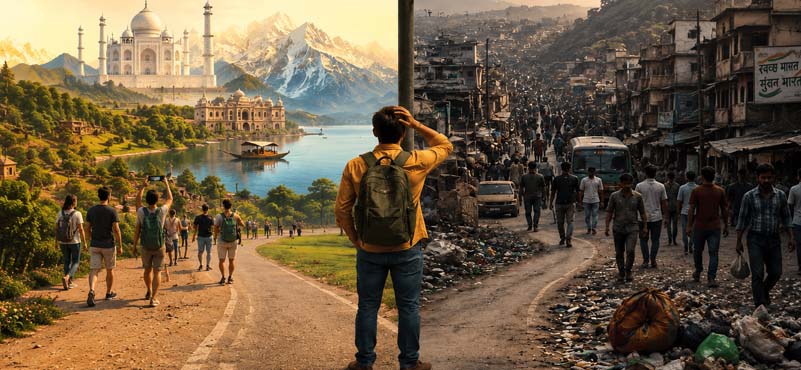
India’s Tourism Paradox: Why Bangkok Outdraws a Subcontinent

At a recent address in Bangkok hosted by the India–Thai Chamber of Commerce, Indian parliamentarian and diplomat Shashi Tharoor advanced a formulation that, while rhetorically simple, exposes a deeper macroeconomic imbalance in India’s services export architecture: India, despite its civilisational scale, demographic depth, and global cultural visibility, continues to significantly underperform in international tourism conversion.
His most cited comparison—Bangkok attracting more visitors in a single month than India receives in a full year—functions less as exaggeration and more as a structural signal.
The empirical divergence supports the claim.
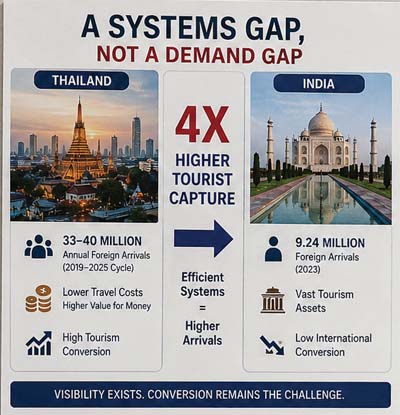
Thailand’s inbound tourism cycle has stabilized in the 32.97–39.8 million annual arrival range (2019–2025 cycle), while India, despite its top-tier global GDP status, recorded only 9.24 million foreign tourist arrivals in 2023, recovering unevenly from its pre-pandemic peak of 17.9 million in 2019.
This is not a volatility gap. It is a systems gap.
What Shashi Tharoor said
In his address, Shashi Tharoor directly outlined the structural imbalance in India’s tourism model, contrasting pricing, governance, and institutional capability with Thailand’s tourism system:
“Thailand is historically very much cheaper to visit for a tourist than India, and that’s ironic because in many ways your per capita income is higher than ours so we should actually be cheaper than you. But that’s just one example of something India could do differently on the marketing and promotion stuff.”
He stressed that India’s tourism weakness is not demand-side but executional, particularly in institutional design and promotional capability:
 “Yes, the government can invest effort but the honest truth is bureaucrats are not great at this stuff… I’ve seen Indian tourism promotion over decades except for a few inspiring exceptions like my friend Amitabh Kant who devised the Incredible India campaign.”
He further highlighted a structural role mismatch between state and market:
“A lot of tourism promotion is not well done by government officials… they’re schooled in a different way or approach to things. What we need are tour operators, private sector people who actually do tours—not just welcoming people in India but also going out and attracting people by selling packages.”
On governance and infrastructure, he argued for a clear division of responsibility:
“The government can facilitate a lot of things by improving infrastructure in tourist areas, improving regulations that govern everything from hawking to begging to sanitation waste disposal… not so much tourism promotion. Let the private sector do that, but let the government handle infrastructure, tax incentives and so on that make tourism viable and affordable.”
He concluded with a stark scale comparison:
“I mean I think Bangkok gets in one month more tourists than the whole of India gets in a year.”
Return to analytical frame
The empirical divergence supports the claim.
Thailand’s inbound tourism cycle has stabilized in the 32.97–39.8 million annual arrival range (2019–2025 cycle), while India, despite its top-tier global GDP status, recorded only 9.24 million foreign tourist arrivals in 2023, recovering unevenly from its pre-pandemic peak of 17.9 million in 2019.
This is not a volatility gap. It is a systems gap.
A paradox of income, price formation, and service export efficiency
At the core of India’s tourism underperformance lies an unusual macroeconomic inversion: Thailand, with a GDP per capita of approximately $8,400–$9,000, consistently delivers a lower-cost tourism basket than India, where GDP per capita remains near $2,500–$2,600.
This violates a standard comparative pricing expectation. In most tradable and non-tradable service sectors, higher income levels correlate with higher cost structures. Tourism in Thailand breaks this relationship due to structural efficiency in supply-side organisation.
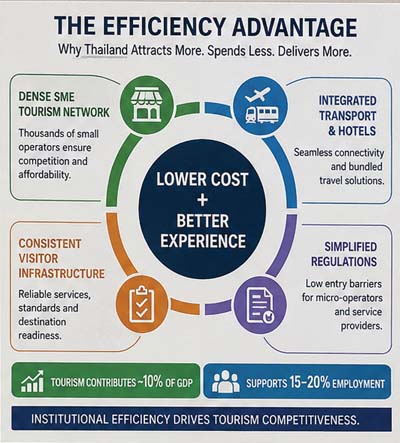
The Thai model compresses consumer prices through:
dense SME competition across hospitality and food ecosystems high elasticity of street-level service supply low regulatory entry barriers for micro-operators integrated transport and accommodation bundling at scale
As a result, Thailand achieves a rare macro outcome: higher national income levels coexist with lower tourist marginal costs.
India’s structure is the inverse. Tourism pricing is shaped not by market density but by administrative fragmentation. Accommodation, transport, and services are embedded in overlapping state-level regulations, heterogeneous municipal taxation regimes, and layered compliance costs that accumulate across the value chain.
The outcome is a structural inversion:
Thailand behaves as a high-volume, low-friction export service economy, India behaves as a low-conversion, high-friction domesticised service system.
Scale economics: divergence in global tourism capture
The gap between the two economies is not incremental—it is exponential in scale elasticity.
Thailand’s tourism system operates at sustained global intensity:
- 39.8 million international arrivals (2019 peak cycle)
- 35.55 million arrivals (2024)
- 32.97 million projected arrivals (2025)
- 3.71 million arrivals in a single month (Jan 2025 peak)
That monthly peak alone approaches or exceeds India’s full-year inbound tourism volumes in multiple recent cycles, underscoring the intensity differential in global conversion throughput.
India’s inbound trajectory remains structurally lower:
- 17.9 million arrivals (2019)
- 9.24 million arrivals (2023)
This represents a 2x–4x structural under-capture of global tourism demand, even after controlling for pandemic recovery effects.
The issue is not demand absence. It is conversion architecture failure.
Tourism as macroeconomic infrastructure, not discretionary consumption
Thailand treats tourism as a core GDP engine, not a peripheral services category.
Its contribution structure reflects this integration:
- approximately 10.6% of GDP (2019 baseline)
- 15–20% of total employment absorption
Tourism in Thailand therefore functions as a labour market stabiliser, SME financing channel, and regional development engine simultaneously.
India’s tourism sector, while larger in absolute aggregate value, operates at lower intensity density:
- 6.6–6.8% GDP contribution range
- 76.17 million jobs (direct and indirect, 2022–23)
- ₹3.1 trillion international visitor expenditure (2024, +9% vs 2019)
- ₹19.13 trillion sector output (2023 baseline expansion)
However, India’s defining feature is not international tourism—it is domestic scale:
- 2.509 billion domestic tourist visits (2023)
This represents one of the largest internal tourism circulations globally, but with weak foreign exchange translation efficiency, limiting its macro external-account impact.
Marketing inefficiency and conversion discontinuity
India’s global tourism positioning, led historically by the “Incredible India” campaign, succeeded in awareness creation but failed in demand conversion architecture.
The core weakness is structural discontinuity between branding and transaction systems.
Thailand resolves this through vertically integrated coordination:
airline pricing alignment with tourism authority hotel inventory synchronisation with demand cycles destination management organisations embedded in distribution networks low-cost carrier expansion supporting regional demand flows
This produces a closed-loop conversion system where marketing directly feeds transaction volume.
India’s system remains horizontally fragmented:
global awareness exists but booking conversion remains inconsistent and distribution remains intermediated and uncoordinated
The result is a persistent leakage between visibility and monetisation.
Friction economics: the invisible tax on tourism demand
Tourism pricing is not determined by headline hotel rates or flight fares, but by cumulative friction costs embedded in system design.
 India’s friction stack includes:
multi-jurisdiction licensing complexity across states and municipalities inconsistent local taxation structures applied to tourism services informal transaction costs in mobility, parking, and entry systems variable sanitation quality across high-footfall destinations
Individually marginal, collectively these factors function as a non-cash friction tax on tourism consumption, raising both perceived and realised cost structures.
Thailand eliminates much of this friction through standardisation:
uniform regulatory frameworks for street commerce predictable transport pricing systems standardised hospitality classification regimes consistent sanitation and tourist-zone governance
This reduces uncertainty premiums embedded in travel decisions.
Infrastructure asymmetry and geographic concentration risk
 Thailand’s tourism system benefits from hub-and-spoke aviation architecture, reinforced by ASEAN integration and low-cost carrier density.
India’s system exhibits structural concentration risk:
international arrivals heavily clustered in a small set of gateway cities underdeveloped secondary destination absorption capacity inconsistent hospitality infrastructure beyond metros and heritage cores limited last-mile connectivity into high-potential tourism corridors
This creates a bottleneck effect where demand exists but fails to spatially diffuse, limiting multiplier effects on regional development.
Institutional misalignment: the state-market coordination gap
A central structural diagnosis advanced by Shashi Tharoor is institutional role misallocation.
India has drifted into a hybrid model where: state institutions attempt marketing and branding functions private operators remain under-integrated in global distribution systems
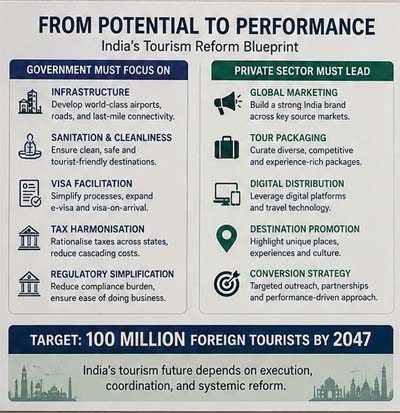 This produces dual inefficiency: weak public-sector execution in infrastructure delivery fragmented private-sector execution in international demand aggregation
An efficiency-maximising model requires strict functional separation:
State responsibilities:
- aviation and transport infrastructure
- sanitation and public-space governance
- visa and entry facilitation systems
- regulatory simplification frameworks
- tax harmonisation for tourism services
Private-sector responsibilities:
- global marketing and destination branding
- pricing strategy and package design
- international distribution networks
- digital conversion and booking ecosystems
This is not ideological design—it is comparative institutional efficiency.
The Institutional Architecture of India’s Tourism State: A Fragmented Ecosystem
Beyond pricing inefficiencies and marketing gaps lies a more structural constraint in India’s tourism economy: a dense but fragmented institutional architecture that disperses authority across ministries, PSUs, autonomous bodies, state departments, and industry associations—often without unified executional coordination.
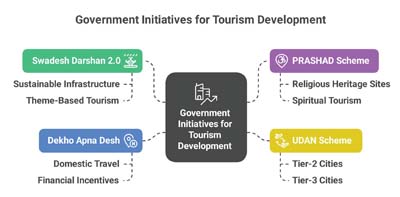 At the centre of this system sits the Ministry of Tourism, Government of India, the nodal authority responsible for national tourism policy formulation and coordination across central ministries, state governments, union territories, and private-sector stakeholders. The Ministry operates under the political leadership of the Union Minister for Tourism, currently Shri Gajendra Singh Shekhawat, with administrative headquarters at Transport Bhawan, New Delhi.
Operational execution, however, is decentralised through the Directorate General of Tourism, which maintains approximately 20 domestic field offices along with specialised projects such as the Indian Institute of Skiing and Mountaineering (IISM) and the Gulmarg Winter Sports Project. This field structure is intended to bridge national policy with regional implementation, though in practice it often reflects uneven capacity across states.
Internally, the Ministry is divided into multiple specialised divisions—ranging from Destination Development, Marketing and International Cooperation, and Research & Analytics, to Skilling, Product Development, and Travel Trade facilitation. The Travel Trade division in particular oversees approvals for inbound and domestic tour operators, adventure tourism operators, and transport service providers, while also managing regulatory frameworks linked to tourist safety, grievance redressal, and the national helpline (1363).
Yet the institutional complexity does not end at the ministry level. A parallel ecosystem of public-sector and autonomous institutions further expands the architecture.
The India Tourism Development Corporation (ITDC) operates as a public-sector undertaking responsible for hotel infrastructure, travel services, and promotional activities. In parallel, the Indian Institute of Tourism and Travel Management (IITTM), the National Council for Hotel Management and Catering Technology (NCHMCT), and a nationwide network of Institutes of Hotel Management collectively shape human capital development for the sector. Specialized institutions such as the National Institute of Water Sports (Goa) further diversify training and niche tourism capabilities.
Financial and operational flows are complemented by sector-specific institutions such as the Tourism Finance Corporation of India (TFCI), which provides dedicated financing for tourism infrastructure and hospitality projects, and by rail-linked tourism operations managed through IRCTC, which integrates transportation with packaged travel offerings.
At the sub-national level, tourism governance becomes even more fragmented. Each state operates its own tourism authority—such as Andhra Pradesh Tourism Authority, Kerala Tourism Development structures, Jammu & Kashmir Tourism bodies, and similar institutions across India—each with distinct branding, policy priorities, and infrastructure capacities. This creates a federal mosaic rather than a unified national tourism platform.
Overlaying this institutional structure are industry associations such as the Indian Association of Tour Operators (IATO) and the Travel Agents Association of India (TAAI), which represent private-sector stakeholders in inbound and outbound tourism markets. These bodies play an important role in advocacy and market coordination but operate largely parallel to government execution systems rather than as fully integrated partners in demand generation.
Finally, flagship initiatives such as the “Incredible India” campaign, the Incredible India Tourist Facilitator (IITF) certification programme, and the national 1363 tourist helpline represent attempts to unify branding, training, and service delivery standards across this fragmented ecosystem.
However, the structural reality remains: India’s tourism governance system is not a single coordinated engine but a multi-layered institutional network with overlapping mandates, distributed authority, and uneven execution capacity across levels of government and industry.
This fragmentation directly reinforces the very inefficiencies highlighted in tourism pricing, marketing discontinuity, and experience variability—turning institutional design itself into a binding constraint on India’s global tourism competitiveness.
Pricing architecture distortion
India’s tourism cost structure is shaped by cumulative systemic distortions:
overlapping taxation layers across jurisdictions fragmented compliance ecosystems for operators heterogeneous fee structures across states and cities inefficient licensing regimes for hospitality SMEs
These distortions elevate operating costs for hotels, transport providers, and tour operators, ultimately transferring into final consumer pricing.
Thailand achieves the opposite effect: margin compression through competition, volume expansion through scale, and price deflation through efficiency density.
The missing middle: structural gap in hospitality economics
India’s hospitality market exhibits a structural bifurcation:
high-end luxury hotels concentrated in metros and heritage destinations low-end informal or inconsistent accommodation in secondary locations
Absent is the mid-market scalable hospitality layer, which globally drives mass tourism:
standardised quality predictable pricing replicable operational models chain-based scalability
Without this layer, India cannot efficiently absorb mid-income global tourism demand even if inflows increase.
Investment implications: tourism as infrastructure alpha
The policy implications extend beyond tourism into growth infrastructure capital allocation.
High-impact reform vectors include:
unified licensing frameworks for homestays and tour operators GST rationalisation across tourism value chains creation of integrated tourism economic zones tier-2 and tier-3 airport expansion strategies sanitation-led urban redevelopment in tourism clusters formalisation of street commerce in tourism corridors hospitality skill certification ecosystems SME financing for mid-tier hotel expansion bundled multi-destination export tourism products
These measures collectively reposition tourism from discretionary services to export-grade infrastructure economics.
Macroeconomic upside: underpriced services export potential
India’s tourism sector already contributes over 6% of GDP, supports tens of millions of jobs, and generates rising foreign exchange inflows.
Yet the gap between realised and potential value remains structurally large.
If efficiency constraints are resolved, India could plausibly scale inbound tourism several-fold, moving closer to Thailand-like intensity without replicating Thailand’s geographic or demographic conditions.
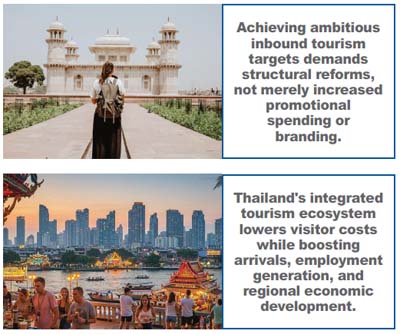
The government’s ambition of 100 million inbound tourists by 2047 is economically plausible only under conditions of structural reform, not incremental promotional spending.
Outlook: from narrative paradox to execution deficit
India’s tourism paradox is not an attractiveness failure—it is a systems conversion failure.
The country possesses unmatched civilisational, cultural, and geographic assets, but underperforms in packaging efficiency, pricing architecture, regulatory coherence, and global distribution integration.
Thailand’s advantage is not cultural endowment—it is institutional design efficiency.
As Shashi Tharoor implicitly frames it, the binding constraint is not visibility but execution: the state must build enabling infrastructure, while the market must convert demand into scalable tourism exports.
Until that separation is structurally enforced, India will remain a global anomaly—highly admired, widely recognized, but persistently under-monetised in one of the world’s fastest-growing services export sectors.