
Over 50 years of Tourism Advocacy
Building India's Travel Businesses
Tourism Without Responsibility Is Destroying the Indian Himalayas

The Himalayas have long occupied a sacred place in India’s collective imagination. Towering peaks, pristine rivers, dense forests, and spiritual retreats have drawn millions of pilgrims, trekkers, and leisure travellers for generations. Destinations such as Manali, Shimla, Mussoorie, Nainital, Dharamshala, Kasol, Kedarnath, and Leh have become synonymous with mountain tourism. Yet beneath the postcard-perfect imagery lies an increasingly disturbing reality: many of India’s most popular Himalayan destinations are struggling under the weight of uncontrolled tourism, mounting waste, and deteriorating civic discipline.
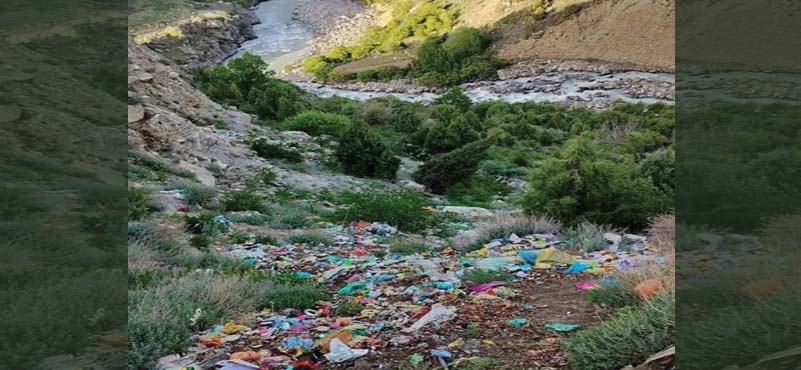
The problem is no longer limited to seasonal littering. It has evolved into a full-fledged environmental and governance crisis. Plastic bottles line mountain roads, food packaging accumulates along trekking routes, rivers carry discarded waste downstream, and scenic viewpoints often resemble open dumping grounds after holiday weekends. What should be symbols of ecological purity are increasingly becoming cautionary tales of neglect.
At the heart of this crisis lies a troubling pattern of public behaviour. Many tourists treat mountain destinations as temporary playgrounds rather than fragile ecosystems. Single-use plastics, disposable cutlery, liquor bottles, cigarette butts, and snack wrappers are routinely discarded despite the availability of dustbins in many locations. The problem is particularly visible during peak tourist seasons when visitor numbers far exceed the carrying capacity of local infrastructure.
Social media has further intensified the issue. The quest for picturesque content often brings crowds to previously secluded locations. Unfortunately, the same visitors who seek untouched natural beauty frequently leave behind traces of consumption and waste. The contradiction is striking: people travel to experience pristine landscapes yet contribute directly to their degradation.
 However, placing the entire blame on tourists would be both simplistic and unfair. Local authorities and tourism administrators must also shoulder significant responsibility. Many Himalayan towns continue to operate with waste-management systems designed for resident populations rather than the massive tourist influx they now experience. During long weekends and holiday seasons, garbage collection systems are often overwhelmed.
In several destinations, inadequate public toilets, insufficient waste bins, poor segregation practices, and irregular collection schedules exacerbate the problem. Illegal dumping sites emerge on town peripheries, while waste frequently finds its way into rivers and valleys. The absence of strict monitoring and enforcement allows irresponsible behaviour to continue unchecked.
Urban planning failures are equally evident. Hotels, guesthouses, roadside eateries, and commercial establishments have multiplied rapidly, often without corresponding investments in sewage treatment, waste processing, and environmental safeguards. As visitor numbers continue to rise, infrastructure development has struggled to keep pace.
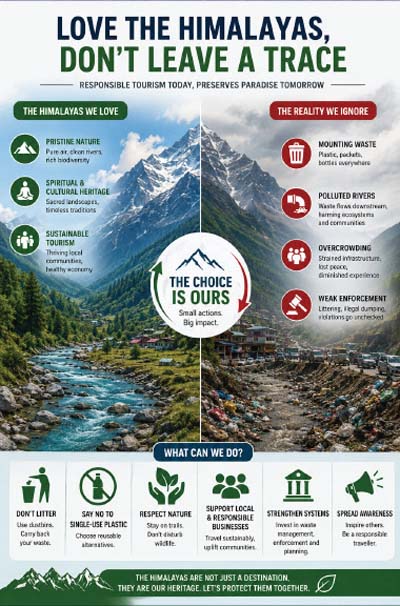
The consequences extend far beyond aesthetics. Accumulated waste threatens biodiversity, contaminates water sources, damages soil quality, and endangers wildlife. Animals frequently ingest plastic waste, while polluted streams affect both ecosystems and local communities. Tourism-dependent economies also face long-term risks. Once a destination acquires a reputation for overcrowding and poor sanitation, its attractiveness inevitably declines.
The challenge, therefore, is not merely environmental but economic and social. Sustainable tourism is no longer optional; it is essential for the survival of Himalayan destinations.
Addressing the crisis requires a multi-pronged strategy involving tourists, businesses, local governments, and state administrations.
First, authorities must introduce stricter enforcement mechanisms. Spot fines for littering, illegal dumping, and environmental violations should be consistently imposed rather than selectively enforced. Successful examples from international mountain destinations demonstrate that visible enforcement significantly influences public behaviour.
Second, waste management infrastructure must be expanded dramatically. Tourist hotspots require dedicated waste collection systems capable of handling seasonal surges. More bins alone will not solve the problem; authorities must invest in segregation facilities, recycling centres, composting units, and modern waste-processing plants tailored to local conditions.
Third, visitor management policies should be considered for highly sensitive destinations. Carrying-capacity assessments can help determine the maximum number of visitors an area can sustain without environmental degradation. Reservation systems, entry permits, and peak-season restrictions may be necessary in ecologically vulnerable zones.
Fourth, tourism businesses must become active stakeholders in environmental protection. Hotels, restaurants, tour operators, and transport providers should reduce dependence on single-use plastics, promote refill stations, and educate visitors about responsible conduct. Sustainability certifications can encourage industry-wide adoption of better practices.
Public awareness campaigns must also move beyond symbolic messaging. Signboards alone are insufficient. Behavioural-change initiatives, community engagement programmes, and digital campaigns should communicate the real environmental costs of irresponsible tourism. Schools, colleges, and travel influencers can play a crucial role in fostering a culture of responsible travel.
Technology offers additional opportunities. Smart waste-monitoring systems, mobile reporting applications, and data-driven tourist management platforms can help authorities identify problem areas and deploy resources more effectively. Real-time monitoring can improve accountability and responsiveness.
Most importantly, tourists themselves must recognise that environmental stewardship is a shared responsibility. Carrying waste back to designated disposal points, avoiding single-use plastics, respecting local regulations, and supporting environmentally responsible businesses are simple actions that collectively create substantial impact.
The Himalayas are more than tourist destinations. They are ecological lifelines, cultural treasures, and spiritual landscapes that sustain millions of people across the subcontinent. Their preservation cannot be entrusted solely to governments or local communities. It requires a fundamental shift in how visitors engage with these fragile environments.
India stands at a critical crossroads. It can continue down the path of unchecked mass tourism and environmental decline, or it can embrace a model of responsible, sustainable mountain tourism. The choice will determine whether future generations inherit pristine Himalayan landscapes—or merely photographs of what once existed.