
Over 50 years of Tourism Advocacy
Building India's Travel Businesses
Indian Air Transport Story: Delayed But On Course!

How the Gulf Crisis, Oil Prices and Airspace Restrictions Are Rewriting India’s Aviation Story
The headlines have focused on the Gulf conflict. Rising tensions in West Asia. Higher oil prices. Airspace closures. Longer flying times. All true and yet the more interesting story is unfolding closer home. For the first time in recent memory, India’s three major private airline groups — Air India, IndiGo and Akasa Air — are facing exactly the same external crisis. The cost of fuel has risen sharply. Flying times have increased. Operational uncertainty has become the norm rather than the exception. And yet each airline has reacted differently, as each of them found themselves in situations peculiar to their growth story, forced to react.
One has retreated. One has adjusted. One continues to expand. Together, they provide a fascinating insight into the future direction of Indian aviation.
The Perfect Storm
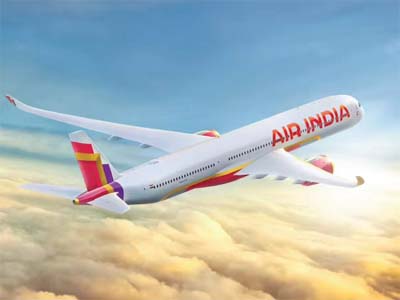 The trigger has been the continuing instability across West Asia. The conflict, as we all know and witnessed over last few months, has pushed up crude oil prices and, consequently, Aviation Turbine Fuel (ATF), which remains the single largest cost component for airlines. At the same time, Pakistan’s continued closure of its airspace to Indian carriers has forced aircraft flying westwards towards Europe and North America onto longer routings.
Flights now consume more fuel. Aircraft spend more hours in the air. Crew costs rise. Fleet utilisation declines. Operating economics deteriorate.
For airlines already operating on wafer-thin margins, these are not minor inconveniences. They fundamentally alter route profitability. Airlines have therefore been forced to ask a simple question: Which routes are worth operating and which are not? The answers have differed dramatically.
Air India: When Ambition Gets A Jolt
 No airline entered 2026 with greater ambition than Air India. Following the Tata takeover, the airline announced a historic order for 470 aircraft, unveiled a new brand identity, inducted new-generation Airbus A350s, merged Vistara into its operations and spoke confidently of challenging the world’s leading network carriers. Then the emerging reality arising out of the West Asia war, with its implications, intervened and shook some of the fundamentals that till then had not become major.
In May 2026, Air India announced one of the most significant network rationalisations in its recent history. Between June and August, it cut approximately 145 international flights every week and reduced services across 29 international routes. The airline specifically cited record-high jet fuel prices and continued airspace restrictions as the principal reasons.
The cuts were not confined to one region. Delhi-Chicago was suspended. Delhi-Shanghai was suspended. Mumbai-New York JFK was suspended. And then Delhi-Paris was reduced, so was Delhi-San Francisco and Delhi-Toronto.
Services to Melbourne, Sydney, Singapore, Bangkok, Kuala Lumpur, Colombo and several SAARC destinations were also scaled back.
Industry estimates suggest Air India reduced international capacity by approximately 27 percent during the period. Domestic reductions were equally severe, with planned domestic capacity cut by around 22 percent. Some estimates indicate domestic schedules falling from roughly 15,900 flights in May to around 11,600 in June.
The significance lies not merely in the flight cuts.
More important are reports that Air India is reportedly seeking to defer deliveries of hundreds of aircraft from Airbus and Boeing. If confirmed, that represents a fundamental shift in strategy. Aircraft orders are statements of confidence. Aircraft deferrals are acknowledgements that growth assumptions have changed. The airline is also reportedly reviewing expansion plans at new gateways such as Noida International Airport. Mind you, reviewing does not mean any halt, perhaps best to calling it possible staggering, defraying newer capital costs over a longer period.
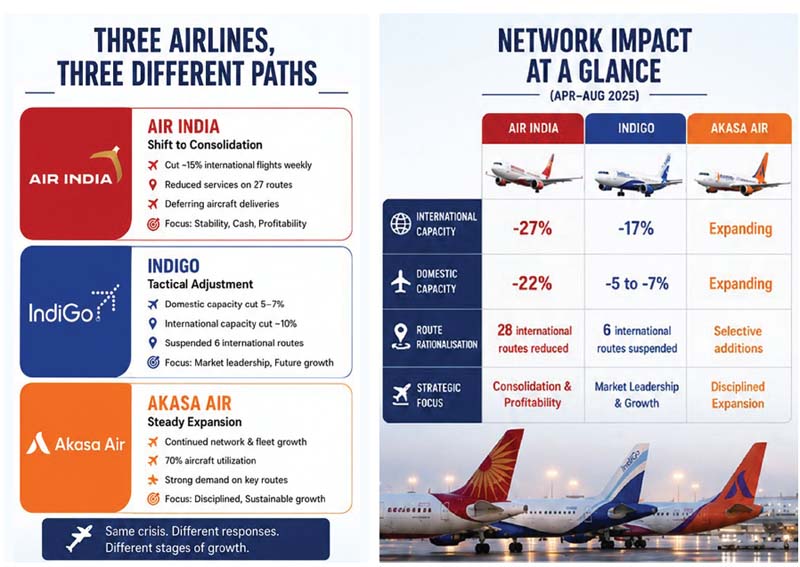
In simple terms, Air India has moved from expansion mode to consolidation mode. Its focus today is no longer growth at any cost. It is operational stability, cash preservation and a return to profitability.
Indigo: The Market Leader Absorbs The Shock
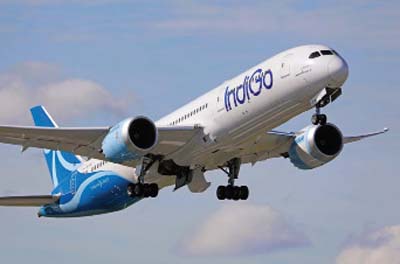 IndiGo has been hit by exactly the same external pressures. Its fuel bill has risen. Its flying times have increased. Its international operations have become more expensive. Yet its response has been notably more measured, perhaps it was in a position that could make the impact less.
The airline announced domestic capacity reductions of between 5 and 7 percent between June and August 2026. International capacity was reduced by around 17 percent. IndiGo also suspended six international destinations, including Hong Kong and Shanghai, while discontinuing services on selected routes where economics had deteriorated.
However, unlike Air India, IndiGo has not altered its medium or long-term growth thesis.
The airline continues to dominate the domestic market with a share exceeding 60 percent. It remains committed to fleet growth, long-haul ambitions and expansion through new airports. Even while trimming capacity, IndiGo has continued investing in future growth opportunities.
The distinction is important. Air India is cutting because growth has become difficult. IndiGo is trimming because operating conditions have become temporarily unfavourable. The former is strategic retrenchment. The latter is tactical adjustment. The difference lies in the different stages of their overall growth phase, one building across year on year, while Air India had begun to re-write a new chapter.
IndiGo’s message to investors and the market remains clear: the long-term Indian aviation growth story is intact.
Akasa Air: The Quiet Contender
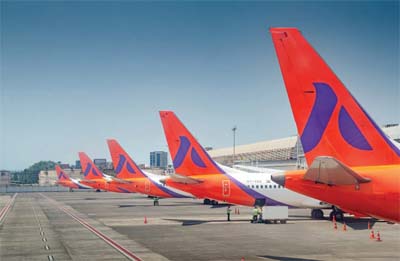 The third airline often receives less attention, partly because it is not in the big race, or perhaps it prefers to stay quiet. Yet its response may be the most revealing of all. Akasa Air entered the crisis from a very different position. Unlike Air India, it has no legacy baggage. Unlike IndiGo, it is not defending a dominant market share. It is still building.
The Gulf crisis has undoubtedly affected Akasa. Higher fuel costs and longer flying times hurt every airline. However, Akasa’s primary challenge remains aircraft availability rather than demand. Boeing delivery delays have slowed the arrival of aircraft that were central to its growth plans. Yet despite these challenges, Akasa continues to expand.
The airline closed FY 2025-26 with 37 aircraft, representing fleet growth of more than 35 percent year-on-year. Its Summer 2026 schedule envisaged a 22 percent increase in network capacity, with particular emphasis on Gulf markets such as Jeddah, Riyadh and Abu Dhabi.
While Air India was reducing frequencies to preserve cash, Akasa was adding aircraft. While Air India was discussing aircraft deferrals, Akasa continued pursuing its long-term plan to grow towards a fleet of 226 aircraft by 2032. In many respects, Akasa represents a third model. Neither retrenchment nor dominance. Steady, disciplined expansion. The airline’s strategy appears to be based on patience rather than scale.
The Bigger Question For India
The immediate effects of the Gulf crisis will eventually pass. Oil prices will stabilise and airspace restrictions will ease. Demand will return. The more important question is what the crisis has revealed about Indian aviation. For decades, India has aspired to become a global aviation hub. Yet successful hubs are usually built around powerful home carriers.
Like Dubai has Emirates and Doha has Qatar Airways; Singapore has Singapore Airlines while Istanbul has Turkish Airlines. These also become the flag bearers, like flying the flag. They also focus on the country’s tourism, by virtue of proving to the airline world that they can hub over them. India’s challenge has always been different. Its market is enormous. Its growth is undeniable. But its airlines remain at very different stages of maturity.
The Gulf crisis has exposed those differences with unusual clarity. Air India is still rebuilding. IndiGo is consolidating leadership. Akasa is quietly establishing itself as a credible third force. For the time being, our ideas of making Delhi and Mumbai become global hubs will also get delayed, which becomes a given. Though, on the flip side, effective hub and spoke could also give them an extra edge, provided these open new routes and traffic.
The Road Ahead
The irony is that none of these airlines can actually be faulted. It is like being caught and bowled by an unexpected twist in the pitch. Air India’s caution is understandable given its losses, integration challenges and international exposure. Also, it has been caught in that unusual position where the airline is in the midst of leadership change. The current incumbent has put in his papers and set to go; a replacement has been talked about. The emerging situation throws a new kind of challenge for whoever takes up the mantle. It will not be an easy job to take on.
IndiGo’s confidence is justified by its market leadership and financial strength. Akasa’s measured expansion reflects the realities of a young airline still establishing its footprint. The same crisis has therefore produced three entirely different responses. That may ultimately become the defining aviation story of 2026. Not the war. Not the oil prices. Not even the flight cuts. But the fact that when turbulence arrived, India’s three leading airlines looked at the same storm and chose three different flight paths. And in doing so, perhaps revealed what each one is forced to tread.
Delayed, Not Derailed
There is a tendency during periods of uncertainty to confuse a pause with a reversal. That would be a mistake. The events of 2026 have undoubtedly forced India’s airlines to rethink their immediate priorities. Airport operators are recalibrating traffic projections. Investors have become more cautious. Yet none of this alters the central reality. India remains one of the few major aviation markets in the world where the long-term growth story remains overwhelmingly intact.
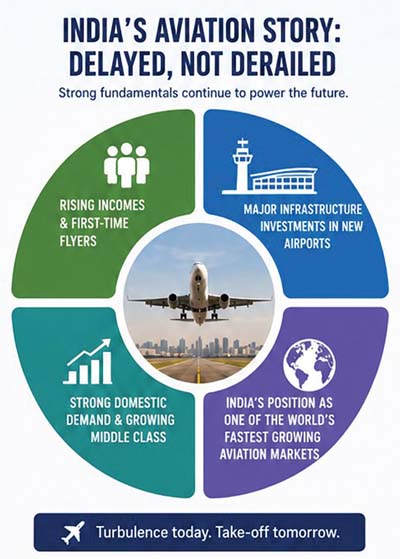 The reasons are structural rather than cyclical. A population exceeding 1.4 billion with a rapidly expanding middle class. Rising disposable incomes and growing regional connectivity. Hundreds of millions of Indians have still not taken their first flight. A government continuing to invest heavily in airports, air navigation systems and aviation infrastructure.
None of these drivers have disappeared. What has changed is the pace at which the industry can capitalise on them. Aviation forecasts produced over the past five years often assumed uninterrupted growth. Passenger traffic would rise steadily. Aircraft would arrive on schedule. Fuel prices would remain manageable. Airspace would remain accessible. Airports would fill up quickly. Capacity would always find demand. The reality has proved more strenuous, but it has not altered, so to say.
Aircraft manufacturers have struggled to meet delivery commitments. Geopolitical tensions have disrupted traditional flight paths. Oil prices have become increasingly volatile. Airlines have discovered that rapid expansion is far easier to announce than to execute profitably. As a result, the industry’s growth curve has flattened temporarily. But it has not changed direction. The best way to understand the situation is to imagine a journey that was expected to take ten years but may now take twelve. The destination remains the same. The arrival time has shifted.
Therefore, new airports such as Noida and Navi Mumbai may take longer to achieve their projected passenger volumes. Indeed, the most striking aspect of the current crisis is that nobody is talking about the industry shrinking. Nobody is suggesting fewer airports. Nobody is cancelling major aircraft orders. Nobody is questioning whether Indians will continue to travel. The debate is entirely about timing, the pause within the growth story.
And timing matters. For investors, it affects returns. For airports, it affects profitability. For airlines, it affects fleet planning. For governments, it affects infrastructure utilisation. But it does not invalidate the larger proposition. India is still expected to become one of the world’s largest aviation markets. It is still expected to add millions of new passengers every year. It is still expected to require hundreds of additional aircraft and dozens of expanded airports.
What Happens To India’s Growth Story
The Gulf crisis may therefore be remembered not as the event that halted Indian aviation’s rise, but as the event that reminded the industry that growth must be built on sustainable foundations. If we look only at India, it appears as though the Gulf crisis, oil prices and airspace restrictions have slowed an otherwise unstoppable aviation story. But when viewed against the global backdrop, India may actually emerge looking stronger than most.
The world itself is entering a period of aviation uncertainty. Europe is grappling with weak economic growth. Germany has barely grown in recent years. Several airlines continue to face labour shortages, aircraft delivery delays and environmental regulations that are raising costs. China’s aviation recovery has been slower than many expected. International traffic is still not uniformly back to pre-pandemic expectations, and consumer confidence remains uneven. North America remains strong, but mature. Growth rates there are incremental rather than transformational. The Middle East remains robust, but even the Gulf carriers are exposed to the very geopolitical tensions now affecting the region.
Aircraft manufacturers themselves have become a bottleneck. Airbus has thousands of aircraft on order but struggles to deliver them on schedule. Boeing’s problems are even more widely documented. Airlines everywhere are discovering that growth plans can be constrained not by demand, but by the inability to obtain aircraft.
Against this backdrop, India’s position remains remarkably favourable. The country is still adding airports. Still building terminals. Still creating new routes. Still bringing first-time flyers into the system. Still seeing double-digit growth on many domestic sectors. Still generating one of the world’s largest aircraft order books.
It may be more accurate to describe it as a global aviation correction in which India remains one of the strongest performers. For example, if global passenger traffic grows at 3–4% annually while India continues growing at 8–10%, India remains one of the most dynamic aviation markets anywhere. The numbers may not match the exuberant forecasts that were being circulated when the Air India aircraft order was announced, but they remain exceptional by global standards.
In fact, one could argue that the events of 2026 have done something useful. They have separated aspiration from reality. A few years ago, almost every forecast assumed uninterrupted growth, ever-rising passenger numbers, immediate aircraft deliveries and instant profitability. Today the industry is becoming more realistic. That is not unique to India. It is the history of aviation globally.
The Gulf crisis has undoubtedly delayed parts of India’s aviation journey. But when compared with the rest of the world, India still stands out as one of the few major markets where the long-term trajectory remains overwhelmingly upward.
The Indian Traveller, Not Giving Up On Travel
For the Indian traveller, what has changed is the cost of travel. Higher airfares, particularly on international routes affected by longer flying times and fuel costs, inevitably make some travellers postpone trips, shorten holidays or choose destinations closer to home. The outbound market is probably where the first signs of caution emerge. Europe has become more expensive. Long-haul travel to North America has become more expensive. West Asia has become psychologically less attractive for some travellers because of the continuing tensions. Even travellers who fully understand that Dubai, Abu Dhabi or Doha remain safe may become more hesitant when nightly television news is dominated by images from the region. That does not necessarily mean they cancel travel. It may simply mean they choose Thailand over Europe, Vietnam over the Mediterranean, or Kerala over a foreign beach holiday.
Historically, Indians have shown a remarkable ability to adapt rather than stop travelling altogether. During periods of rupee weakness, they choose shorter trips. When fares rise, they travel off-season. When international travel becomes expensive, domestic tourism benefits. When one destination becomes difficult, another gains. That adaptability has always been one of the strengths of the Indian travel market.
Travel is no longer viewed as an occasional luxury. For a large section of the urban middle class, travel has become a lifestyle choice. Weddings, family gatherings, work-from-anywhere arrangements, weekend breaks, pilgrimage, wellness retreats and experiential holidays have all become embedded in consumer behaviour. That makes demand more resilient than many assume.
Travel pauses briefly. It adjusts and soon it returns, often stronger than before.
Traffic Rights, When Is The Good Time To Open The Market?
What happens to the bigger question of connectivity into India? For years, India’s aviation policy has rested on an unspoken assumption: Give Indian airlines time to become stronger before opening the gates too widely. The argument was understandable, though frequently challenged.
Why allow unlimited expansion by Gulf carriers when Indian airlines were weak? Why grant additional bilateral rights when Air India was struggling under government ownership? Why permit foreign airlines to dominate long-haul traffic if India hoped one day to build its own global champions? The logic was essentially nation-building. Protect today, compete tomorrow. The problem has been that this ‘tomorrow’ keeps moving.
When Air India was government-owned, the argument was to wait until Air India was fixed. Then came the Tata takeover. The argument became: wait until Air India transforms itself. Then came the 470-aircraft order. The argument became: wait until those aircraft arrive. Now we are seeing route cuts, deferred deliveries and delayed expansion plans.
The question naturally arises: How long should the market have to wait?
That is particularly relevant because international demand from India has not disappeared. If anything, it continues to grow. But capacity remains constrained, while demand remains strong. Therefore, fares remain elevated. If capacity expansion itself slows, the economics begin to look different. Therefore, there would be pressures upon the government to liberalise more traffic rights. Not necessarily because foreign airlines are demanding them. But because Indian travellers, exporters, tourism stakeholders and airport operators may increasingly ask:
“If Indian airlines cannot immediately provide the additional capacity, why should passengers continue paying scarcity premiums?”
The answer is not straightforward. Open the market completely and Indian carriers face immense competitive pressure. Keep it tightly controlled and fares remain high while capacity remains constrained. The ideal solution would have been a rapidly expanding Air India, IndiGo entering long-haul markets aggressively, Akasa growing steadily, and new airports adding capacity simultaneously. That was the vision many saw only two years ago. What the Gulf crisis and current aviation slowdown have done is stretch the timeline.
“Can India continue restricting foreign capacity while simultaneously postponing the expansion of its own airlines?”
That is likely to become one of the defining aviation policy debates of the second half of this decade.
ABOUT THE AUTHOR
 Navin Berry, Editor, CS Conversations, over five decades has edited publications like CityScan, India Debates and Travel Trends Today. He is the founder of SATTE, India’s first inbound tourism mart, biggest in Asia.
Blogs at: https://www.csconversations.in/nb-blogs