
Over 50 years of Tourism Advocacy
Building India's Travel Businesses

A Staggering Loss of 26,000 crores would Dent the Deepest of Pockets

The reported loss of Air India carries an Epic Short-lived Legacy of Vistara and the Burden of History
Reports suggest turbulence in the boardroom within the Air India Group. Not surprising, that the reported losses of early ₹26,000 crore at Air India are not merely a financial event. Do they represent something much larger? Is it a moment of reckoning for Indian aviation itself. What was once projected as one of the greatest corporate revival stories in modern India has suddenly entered a zone of uncertainty, introspection and difficult questioning.
When the Tata Group reacquired Air India, the mood across the country was one of emotional optimism. A government that had tired of running a continuous loos making airline was convinced that it was the government’s job to run an airline. Better late than never, they say, it was sound reasoning. There was perhaps no Indian corporate house better placed to revive the national carrier. The airline itself had been founded by the Tatas. The return appeared almost poetic — a homecoming of the Maharaja to the very group that had first dreamt of Indian aviation. It was an emotive issue for the late Ratan Tata, who was himself a pilot, and one who also carried forward the legacy of JRD, who was instrumental in awakening the industry in India. It was, indeed, natural for the government to request Tata Group to take over the airline, howsoever daunting the task it seemed. If Tatas then seemed wary of buying the airline and running it again, the government sweetened the bitter pill, offering commercials that should have worked. But even there, it said in retrospect, the airline without its other ancillary services became a more difficult task?
The expectation was not simply financial recovery. The thought process was simple, as also it was institutional redemption. The belief emerged that professionalism would replace bureaucracy, accountability would replace inertia that had seeped within the government owned airline over decades, and that global standards would replace decades of decline.
Yet today, the questions surrounding Air India are becoming sharper rather than softer. How did losses rise to such extraordinary levels? Was the transformation, from being a government entity to a private enterprise, attempted too aggressively? Did the merger strategy of bringing Vistara within the Air India stable, as almost the first steps, repeat historical mistakes? And perhaps most importantly: Did Indian planners and policy makers once again underestimate the importance of culture in aviation? Remember the merger of Air India and Indian Airlines, which in many ways never happened.
The Scale of the Losses
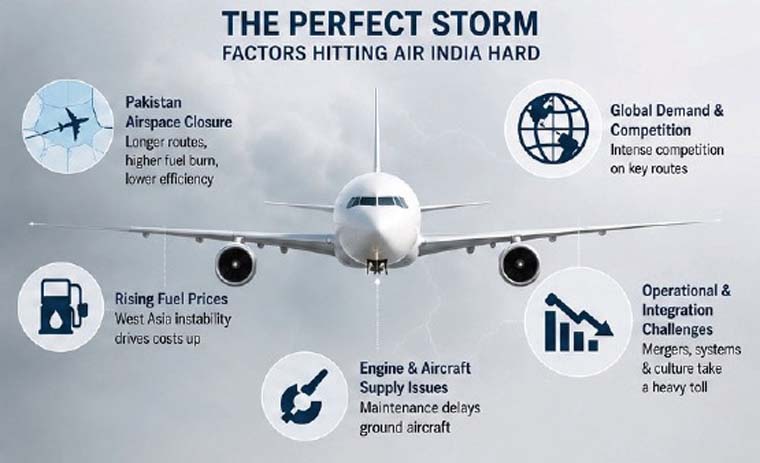
A loss approaching ₹26,000 crore is not a normal airline downturn. Even by global standards, it is severe. Before any blames can be cast, indeed, luck and the turn of following events, never seemed to favour the airline. Many of the lead issues on the surface, which also brought about the losses undoubtedly came from genuine external shocks. Like the closure of Pakistani airspace, higher fuel prices due to West Asia instability, longer international routings, aircraft supply chain shortages, and global engine maintenance delays.
For Air India, which is heavily dependent on westbound long-haul international traffic, the Pakistan airspace issue was particularly damaging. Flights to Europe and North America became longer and more expensive. Fuel burn increased sharply. Crew duty hours extended. Aircraft utilization weakened. Wide-body economics deteriorated rapidly. And unlike low-cost domestic carriers, Air India could not simply retreat inward because its strategy itself was built around becoming a major international network airline.
But do these geopolitical shocks alone explain the entire story? These took place while the airline was simultaneously busy with its internal issues, that Air India attempted multiple transformations: mergers, rebranding, global expansion, premium repositioning, fleet renewal, systems integration, and organizational restructuring. In effect, the airline attempted to rebuild itself mid-flight and this carried enormous execution risk.
The Vistara Question
Perhaps no decision symbolizes the larger strategic debate more than the merger of Vistara into Air India. Vistara was not merely another airline. It represented something Indian aviation had struggled to create for decades — a genuinely respected premium domestic and international flying experience. It was within a very short span, so much credit came to it, as an acknowledged premium product. Even that short lived glory of flying Kingfisher was forgotten, as it soon boomeranged on the airline. Jet too, after all its glory, fell upon bad times and faded into history. But here was a product that was performing exceedingly well, that passengers associated with calm professionalism, consistency, service quality, reliability, and modern aviation culture.
Vistara had emotional credibility and within itself acquired adequate ‘Indianness’ even though it was a joint venture with Singapore Airlines. Air India, by contrast, had legacy and global recognition, but also decades of accumulated operational and cultural baggage.
Which many of us are promoted to raise the question and ask why it made sense for the stronger premium culture to get absorbed into the weaker and more troubled system? Was the integration necessary? Could not the two airlines be run by the same management, but as two different products that could synchronise their networks, economise on where they could, so long as they did not dilute the premium value of Vistara? Why was the integration done with such urgency? Some would argue the reverse may have made more strategic sense: gradually modernize and absorb Air India into a Vistara-led culture rather than the other way around.
Because while Air India had history, Vistara arguably had the future. The choice was difficult. Perhaps the nation was asking for Air India, so was the government. It was deemed fait accompli, that this was the need of the hour, however incorrect it may have been. If Air India was the brand to be fostered, then Vistara need not have been compromised.
The Forgotten Lesson of Indian Airlines
India has already seen one major aviation integration fail structurally. The merger of Air India and Indian Airlines in 2007 remains one of the most troubled institutional integrations in Indian corporate history. On paper, the merger created one airline. In reality, many insiders believe the cultures never truly integrated: separate loyalties remained, separate identities survived, separate work cultures continued, and emotional divisions persisted for years. This history should theoretically have made future aviation mergers more cautious and gradual. Instead, India once again appears to have pursued speed and structural consolidation ahead of cultural assimilation.
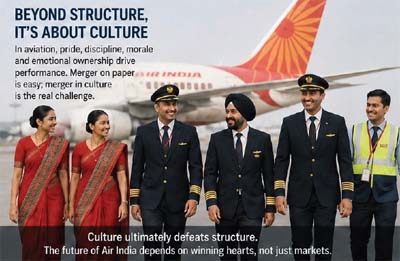
And culture in aviation matters enormously. Airlines are not merely fleets and routes. They are human systems built on: pride, discipline, morale, trust, and emotional ownership.
If employees feel absorbed, diminished or sidelined, they may remain inside the structure physically while psychologically disengaging. In India especially, this dimension becomes even more important. Pride in the product, the organization that you work for, disappears overnight when an award-winning product is told they have been taken over by a struggling brand, and yet to make its name again airline.

Does India Works Differently? Did we not know that?
Western restructuring theories often assume that once reporting structures are aligned and systems integrated, the merger is complete. India often does not work that way. In India memory matters, identity matters, symbolism matters, emotional standing matters.
Indian Airlines itself had enormous domestic recall. For millions of Indians, especially within the country, Indian Airlines was actually more familiar and more visible than Air India. Air India represented international prestige. Indian Airlines represented domestic connectivity. Yet the Indian Airlines identity disappeared almost overnight. Many employees reportedly felt they had not “merged” but had been “subsumed.” That distinction matters deeply in Indian organizational psychology. The same fears may now exist among sections of those who once identified strongly with Vistara’s culture.
Did Air India Expand Too Fast?
Another criticism concerns timing and sequencing. Air India attempted simultaneously global expansion, huge aircraft orders, international premium positioning, mergers, brand transformation, and operational rebuilding. It was all hands-on deck, chasing the bigger picture but underneath, the change was not happening. On the ground, and much beneath it as well, there is much churning and backlash, much of it also can be motivated by hurt egos and bypassed executives. Historically, successful airline turnarounds happen in phases, and there is need to stabilize operations, rebuild trust, and only then expand aggressively.
Air India appears to have compressed several stages together. This may not necessarily reflect lack of vision. The larger ambition itself may still be correct. India probably does need a globally respected network airline. But did the execution sequencing get underestimated and resulted in corresponding operational fragility, cultural integration challenges, accentuated by all the external factors that were also taking place at the same time.
The Air India Crash and its Fallout!
Most tragic perhaps, most of all, was the crash that cost a few hundred lives and dented the reputation for flight safety, regardless of the cause of the crash, which is yet to be determined. It was a horrific moment in recent Indian aviation history and it must have dampened many energies in taking the airline forward. Of course, the past is behind us, but the woes of the Boeing aircraft type history has continued to haunt the airline. Since them periodic glitches continue to be reported, raising many concerns of safety.
The Pakistan Airspace Problem
One question becomes especially important: did Air India initially treat rerouting problems as temporary rather than structural? Because once Pakistani airspace remained closed month after month, the economics of many westbound routes fundamentally changed. It would have been treated as temporary to begin with, but soon thereafter it was apparent that Pakistan was unrelenting in its resolve. Did Air India continued to be optimistic for far too long, longer than was necessary? At that stage, harder strategic decisions normally become necessary: reducing frequencies, slowing expansion, revising network structures, redeploying aircraft, and thereby protecting balance sheets which has become the crux of the problem. Some critics now argue Air India may have persisted too long with a pre-crisis expansion mindset. If true, that would represent not incompetence, but perhaps excessive optimism.
Accountability and the Resignation of the CEO
 The resignation of CEO Campbell Wilson has inevitably intensified questions around accountability. Officially, the transition may have been planned earlier. But timing matters in corporate life. When losses are massive, operational criticism persists, integration pressures rise, and leadership changes occur, the public naturally connects them. Yet the larger issue may not simply be whether individuals should resign.
The bigger question is whether Air India has yet developed a hard commercial accountability culture comparable to the world’s best private airlines. Because airlines operate in brutally unforgiving conditions when delays compound quickly, poor utilization destroys margins, and customer trust erodes rapidly. If course corrections are slow, the market notices immediately.
The Strategic Risk Ahead
The greatest danger now may not be one bad year. The danger is that many of the current pressures appear medium-term or structural. There is geopolitical instability, fuel volatility, aircraft shortages, financing obligations, cultural integration challenges, and intense competition. These do not disappear quickly. They do not look like going away too soon. Everything now depends on whether Air India itself can evolve into the airline India hoped it would become. With a change in guard in the near future, there would be many unresolved challenges for the new incumbent. The country still exists in that mindset that Air India is a national asset, even though it may moved into private hands. The challenge is therefore all that more emotional and financial as well.
Where Does Air India Go from Here?
Air India succeeds spectacularly over time and becomes India’s first truly respected global network carrier. It evolves into a more pragmatic hybrid airline — less obsessed with symbolic prestige and more focused on disciplined profitability. There is also the chance that it remains structurally conflicted — carrying unresolved legacy inefficiencies, fragmented culture and inconsistent execution. The next few years will likely determine which path prevails.
The Final Irony
Perhaps the greatest irony is this: India’s aviation future may depend not on whether Air India preserves the old Maharaja symbolism, but whether it can internally rediscover the qualities that passengers once associated with Vistara – consistency, pride, discipline, professionalism, and emotional trust. The bigger question is how India’s air transport structures will support the country’s economic growth and social mobility. Once the government has exited from both airlines and airports, it has virtually handed over these vital ingredients to the private sector, in public trust. These are now public services run by private hands, subject to public scrutiny and belief as if they own them. The same goes for other services, whether it be electric supply, gas and energy. In aviation, however, culture ultimately defeats structure. And history suggests that when institutions ignore this truth, even the grandest mergers can slowly weaken the very strengths they hoped to inherit.
Meanwhile, how does the SQ equation match this situation? A globally envied airline, that built much of the prestige behind Vistara’s growth, not stands challenged with its share of the Air India losses, impacting its own balance sheets? In the future course of the airline, would Singapore Airlines be allowed a bigger hand in moving forward? Is the partnership here to stay, and what would be its goalposts? This is mere speculation at present but some reports do suggest disquiet in the boardroom in Singapore.
ABOUT THE AUTHOR
 Navin Berry, Editor, CS Conversations, over five decades has edited publications like CityScan, India Debates and Travel Trends Today. He is the founder of SATTE, India’s first inbound tourism mart, biggest in Asia.
Blogs at: https://www.csconversations.in/nb-blogs